
The typical B2B purchase decision involves six to ten stakeholders. It’s no wonder 77% of customers call the process complex. That’s why buyer personas matter in GTM planning: they turn complexity into clarity by mapping decision authority, proof needs, and risk tolerance across the buying group. When personas guide segmentation, messaging, and campaigns, teams close deals faster and align resources more effectively.
The key is how you build them. Most persona documents stop at job titles and surface-level pain points. GTM teams need much more. They need operational systems that drive segmentation, messaging, and deal execution.
In this post, you’ll see why personas drive outcomes beyond theory, how to build data-backed personas around buying roles, and how to plug them into GTM planning (segmentation, campaigns, sales plays, and quarterly refresh cycles).
Why Buyer Personas Matter in GTM Strategy
Before building personas, understand what makes them effective: they prevent misalignment by mapping authority and proof needs, not just collecting demographic data.
The Role of Personas in GTM Planning
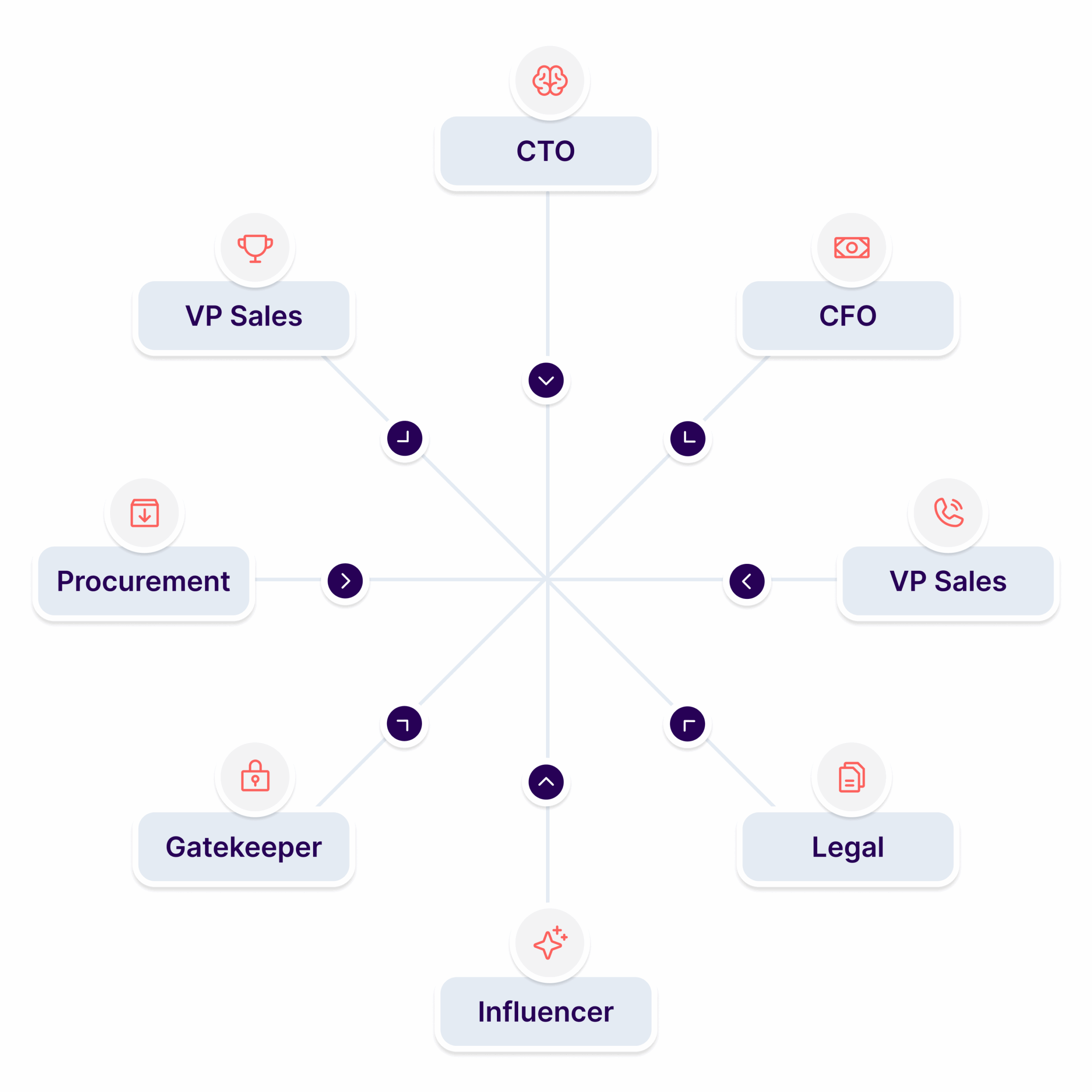
Buyer personas map decision authority, proof preferences, and stage-specific objections (not job titles and company size). As mentioned earlier, the typical B2B buying group includes six to ten stakeholders, each with different priorities, risk tolerances, and veto power. Let’s say a company targets sales leaders and invests three months and $40K into a campaign. Engagement stalls because demos speak to quota attainment (the VP’s priority) instead of workflow efficiency (the Ops Director’s priority, who holds de facto veto power). The VP influences, but doesn’t decide.
This misfire shows what effective personas must capture. First, who holds decision authority at each stage (not just the signer, but influencers, gatekeepers, and veto holders). Second, what proof each role needs to advance: ROI models for CFOs, integration roadmaps for CTOs, user adoption rates for VPs, and risk mitigation documentation for legal and procurement. Third, how risk tolerance shifts as deals progress. Early-stage stakeholders prioritise innovation and speed. Late-stage committees weigh compliance, vendor stability, and total cost of ownership. To sum it up, effective personas answer three questions:
- Who holds veto power at each stage?
- What proof do they need to advance the deal?
- How does risk tolerance shift across the committee?
If yours don’t, they’re demographic profiles (not decision maps).
The Cost of Skipping Persona Work
86% of business buyers say they’re more likely to purchase when vendors understand their goals (and 59% report that most reps don’t.) That empathy gap creates GTM waste. And burns budget.
Misaligned messaging burns budget targeting stakeholders who can’t sign or won’t champion internally. Campaigns optimised for engagement metrics (clicks, downloads, MQLs) generate a pipeline that stalls because the content addressed the wrong role’s priorities. Sales cycles stretch 2–3 months longer in enterprise deals as reps spend discovery calls uncovering objections that personas should have mapped out in advance. CAC climbs as marketing tests channels, messages, and proof types through trial and error.
Here’s how it manifests in the real world. A company targeting CFOs loses three deals to a competitor who sequences their pitch correctly (e.g., ROI concerns in the first call, a technical proof-of-concept in week two, and compliance documentation before contract review). The losing vendor uses the same generic deck for every stakeholder and misses the actual decision path.
The damage extends beyond financials. GTM teams lose confidence when campaigns underperform despite clean execution. Marketing blames sales for poor follow-through, while sales blames marketing for providing unqualified leads. Morale dips, fingers point, and the real issue stays hidden. The root cause (no shared understanding of who decides, what proof they need, and how to sequence engagement) remains undiagnosed.
So you’ve seen why personas matter and what breaks when you skip them. Now build ones that operationalise.
Build Buyer Personas for GTM Success (a five-part process)
Collect Research & Data
Strong persona research reveals decision paths, not demographics. Three data sources reveal how buyers actually decide:
Start with CRM and win-loss analysis. Pull deals you’ve closed in the past 12 months and map who made first contact, who joined calls at each stage, who requested proof (ROI calculators, security docs, references), and who signed. Lost deals teach you just as much because they show where talks stalled, who went quiet, and what ultimately killed the deal.
Run customer interviews with recent buyers. Focus on process, not product feedback. Ask four questions: how they evaluated vendors, who joined the decision, what nearly killed the purchase, and what proof won them over. Run eight to twelve interviews across different deal sizes and verticals (that’s when patterns your sales decks miss start surfacing clearly).
Mine sales call recordings. They reveal committee behaviour in real conversations. You’ll see which roles ask about budget, who requests technical deep-dives, when legal enters the process, and how concerns evolve. This data reveals who actually makes decisions and what motivates them to act.
Identify Key Stakeholders
Map committees by power, not org chart. That distinction matters. Hypothetically speaking, a mid-market HR tech company loses deals because their personas target “CHRO” and “VP People”, but Payroll Directors veto any system touching pay data. Titles don’t predict power. Decision authority does. Use a four-role framework to capture how people shape deals:
- Economic Buyer – Controls budget and holds signing authority (typically a C-level exec who cares about business results, ROI, and strategic fit)
- Champion – Advocates internally and runs the evaluation (typically a director or VP who owns the problem you solve)
- Influencer – Shapes decisions but can’t approve or block (includes subject experts, end users, and adjacent team leads)
- Gatekeeper – Controls access/compliance and can delay/stop (procurement, legal, IT security, finance)
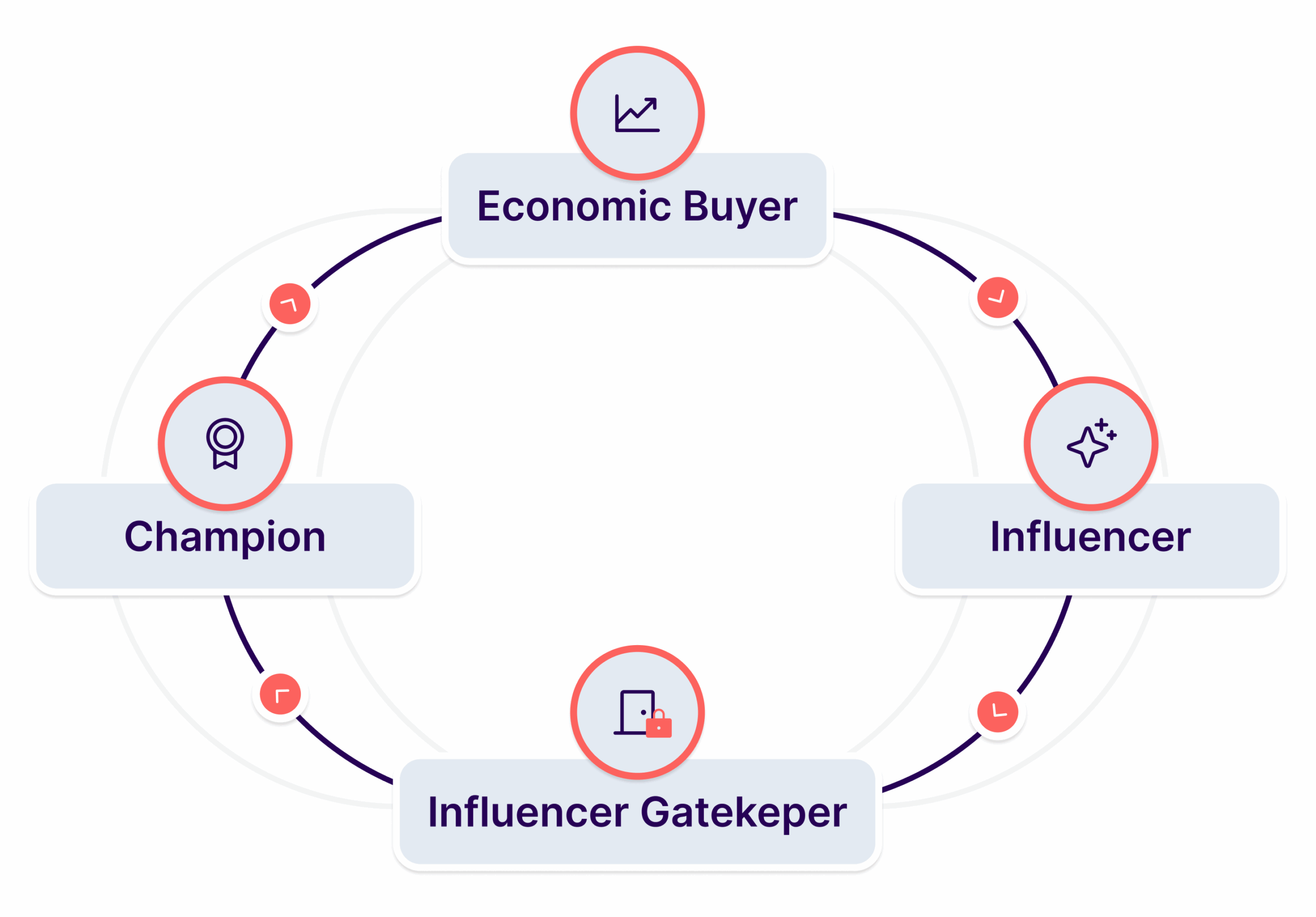
Map each persona to these roles and note when each enters and exits the process. Economic Buyers typically show up late but hold final say, while Champions join early but may lose influence during contract negotiations. Gatekeepers often appear without warning in mid-to-late stage, which is why your personas need to track timing alongside titles to close deals faster.
Pain Points & Goals
Pain blocks outcomes, goals describe future states, and political concerns capture the pressures each role faces. But here’s the problem – generic pain points like “needs better efficiency” don’t drive messaging. Specific, role-based constraints do.
To capture these constraints, structure discovery is conducted around three layers. Start with operational pains (day-to-day issues like manual work, system limits, and resource gaps). Then identify strategic goals, such as revenue growth, cost cuts, competitive wins, and actual compliance gaps. Finally, uncover political concerns, such as the pressures that keep them up at night, like board expectations, team pushback, career risk, and budget scrutiny.
Once you’ve captured these layers, connect each pain to its goal so you position your solution as the bridge. For operational pains, deliver workflow fixes and efficiency metrics. Strategic goals need business models and ROI projections. For political concerns, give them risk assessments and stakeholder briefings.
Messaging & Value Proposition Alignment
Shift your messages by role and stage. Don’t use a one-size-fits-all approach. A cybersecurity platform targeting CISOs utilises different hooks depending on the buyer’s stage:
- Awareness stage – “cut security incidents by 40%”
- Decision stage – “pass SOC 2 audit in 90 days with automated compliance reporting”
A good idea is to lead with outcomes early, then address implementation details and risk controls as the deal progresses.
To put this into practice, build a grid that maps roles, stages, and messages. Then customise your core pitch for each cell so you adjust in real-time without scrambling. At awareness, deliver outcome proof and competitive edge. At consideration, deliver capability checks and technical proof. At decision, deliver implementation plans, support terms, and risk controls.
Within that grid, tailor your emphasis to each persona. Economic Buyers need business outcomes and ROI calculations. Champions need competitor comparisons and customer stories (i.e., ammunition for internal selling). Influencers need technical specs and integration maps to validate feasibility. Gatekeepers need security badges and compliance docs to check their boxes. Match your proof to the role so you advance deals faster.
Journey Mapping
Buyers don’t all enter at once, which is why timing matters. Map when each role joins and what proof they need to move forward. This understanding helps you avoid two common mistakes.
- Assuming all stakeholders review at the same time (they don’t, so sequence your outreach accordingly)
- Assuming early content answers late-stage questions (it won’t, prep stage-specific proof for each phase)
Here’s the typical pattern. Champions usually drive awareness and consideration, so engage them first with competitive differentiation. Economic Buyers and Gatekeepers join the decision-making process, which means you should prepare business cases and compliance documents before they even ask. It also helps if you run the validation check. Does every persona have a clear entry point? Defined proof needs? Specific exit criteria?
Map these to compress your sales cycles. With personas built, the next step is wiring them across your GTM engine.
Using Personas in GTM Planning
Segmenting, Targeting, and Selecting Channels
Start with how buying actually happens (decision authority, proof preferences, risk tolerance), not firmographics alone. Let us take a hypothetical example.
A martech platform segments by company revenue ($10M–$50M) and discovers that 40% of the pipeline stalls. The reason is that buying committees at that range vary wildly. Some have centralised marketing ops teams (single decision-maker, fast cycles), others have distributed teams across regions (consensus-driven, 6+ month cycles). When they resegment around committee structure instead of company size, their ICP suddenly makes sense (and deals might start closing faster.)
That clarity drives three targeting decisions:
- Segment accounts by buying committee composition and decision velocity, rather than by industry and revenue. Prioritise accounts where your champion holds budget authority or where your solution addresses the economic buyer’s top-three strategic goals to compress sales cycles and improve close rates.
- Target the right roles at entry. If research shows that champions initiate 80% of evaluations, focus lead generation there, not on economic buyers who enter late.
- Match channels to consumption patterns. If CFOs in your ICP consume analyst reports and peer networks more than LinkedIn ads, shift budget accordingly to maximise engagement and pipeline quality.
Aligning Marketing, Sales, and Product Positioning
Segmentation clarifies who to target (who to chase). Alignment ensures prospects receive consistent messages across every touchpoint (which rarely happens by accident).
What misalignment looks like:
- Marketing targets “VP Sales” with speed-to-value messaging
- Sales pitches “CRO” with enterprise scalability
- Product positions for “Sales Ops” efficiency
Same company, but prospects hear three different value propositions depending on which team they talk to.
Prevent this by mapping campaigns properly and positioning them to align with consistent persona priorities. Marketing aligns content, channels, and CTAs to specific roles at specific stages (awareness content for champions, decision-stage proof for economic buyers). Sales sequences outreach by entry points (i.e., engage the champion first, deliver the business case when the economic buyer joins). Product emphasises outcomes that match role priorities (e.g., operational efficiency for practitioners, strategic ROI for executives, risk mitigation for compliance teams).
Pull your last campaign brief, sales battlecard, and product positioning doc. Then compare persona descriptions, priority lists, and proof requirements across all three. Any mismatch there becomes friction that needs to be resolved.
Keeping Personas Updated
Personas go stale faster than most teams expect, and that’s when alignment falls apart.
Assign one owner (Demand Gen, Revenue Ops, or Product Marketing), and set a quarterly review cadence. Each quarter, validate that priorities, proof preferences, and committee structures still match deal reality. Review recent win-loss data, call transcripts, and closed deal timelines to spot emerging objections before they stall deals.
Three conditions should trigger immediate updates between quarterly reviews:
- When product pivots or new features change your ICP.
- A new competitor reframes buyer priorities in ways your current personas don’t address.
- When the same objection kills 3+ deals that your personas didn’t anticipate (that’s your market telling you something changed!)
This week, assign one owner, schedule your Q4 review, and define the three specific triggers that will prompt immediate persona updates.
What to Do Next
You’ve seen why personas matter. They align segmentation, messaging, and proof to how buying committees actually decide. You’ve learned how to build them through win-loss analysis and stakeholder mapping, not surveys. And you’ve also seen how to operationalise them with cross-functional alignment and quarterly updates that keep pace with your market.
In simple terms, personas help your GTM work because they show who decides, what proof each role needs, and when to deliver it. When you wire those insights into targeting, messages, channels, demos, and sales plays, deals move faster and waste drops. Keep them fresh quarterly, and your GTM stays aligned with how buyers actually buy.
The difference between personas that sit in slide decks and personas that drive the pipeline is execution. So if you’re running multi-stakeholder deals without these systems in place, book a 30-minute consultation with xGrowth this week. We’ll map your ICP, align your segmentation across teams, and build revenue systems that repeat and scale.
Error: Contact form not found.