


Imagine you’re running an ABM (Account-Based Marketing) campaign targeting a small set of high-value accounts. The buying group is responding to your emails. Interest is climbing. You have a call with a senior stakeholder lined up.
Then, a well-meaning SDR (sales development representative) who isn’t looped into the campaign pulls up an old sequence and sends a generic “quick question” email – completely missing what you’ve already built.
The stakeholder sees it and replies: “Unsubscribe“. Just like that, the momentum dies.
ABM only works when sales and marketing are working on the same plan. That’s when ads, outreach, and sales all move in sync. And when you’re focused on a small set of high-value accounts, every misaligned touch gets noticed fast. That explains why 43% of teams named sales–marketing alignment as one of their biggest challenges.
Because in the beginning, all it takes is one misstep to stall your efforts. When alignment breaks, even one conflicting message can ruin the deal. In this article, we’ll explore why sales and ABM misalignment is fatal, walk through the 5-part framework to keep teams in sync, and show you how to sustain that alignment when priorities shift.
Why Alignment is Non-Negotiable in ABM
When demand gen targets 10,000 leads, the occasional misfire hardly matters. You can absorb it. With ABM, you typically focus on just 50 accounts, so even one mistake is visible. And not just visible to you – visible to them.
Your prospects notice everything. Buying committees aren’t blind to how your teams show up. Every LinkedIn ad, every SDR email, every voicemail from an account executive, and each invite from the CMO is visible. It’s all part of the story they’re building about you in their heads. Each touchpoint shapes their impression, and when your messages don’t sync. When value props conflict, timelines shift, or multiple people ask the same thing, they sense confusion instead of competence.
You’ll immediately recognise these breakdowns in three ways:
- Duplicate outreach: Marketing connects with a VP about cost savings. Sales calls the same person to talk about innovation. It’s actually embarrassing when they point it out.
- Irrelevant content: Sales understands the account is on annual budget cycles, yet marketing insists, “Let’s start a pilot this quarter.” The message misses (completely!)
- Slow follow-up: Executives download a key asset on Friday. The alert just sits there. By Tuesday, sales finally reach out, and it’s already too late. The competitor has already booked the meeting.
By themselves, these missteps seem minor. You could dismiss any one of them. But over a quarter, across those 50 accounts, they quietly wear down your pipeline. Not dramatically. Quietly. And before you know it, you’re wondering why the quarter feels thin. True alignment isn’t “nice to have”. It protects momentum and trust. It’s foundational.
So, how do you actually fix this?
Bring both teams together with a shared scoreboard. Not separate ones. You measure what matters to everyone: account engagement, qualified meetings, pipeline generated, and expansion revenue. Not MQLs. Not open rates. Not campaign impressions. If marketing and sales chase different numbers, they chase different outcomes. But if they rally around the same metrics, inefficiency fades and progress multiplies.
The bottom line is that when your teams disagree on what success means, they’re not truly aligned. They’re just sharing space. Sync up what you measure, and the right tactics will follow. Simple as that.
The ABM Success Framework for Sales–Marketing Alignment
Alignment is more than a one-time agreement. That’s where teams get it wrong. It’s a continuous commitment. Think of it like an operating system. You have to keep it running, keep updating it, keep paying attention to it. The strongest ABM programs rest on five pillars.
Miss one pillar, and the system fails. Lock all five, and high-value accounts experience a seamless journey from first touch to close. That’s when things actually work.
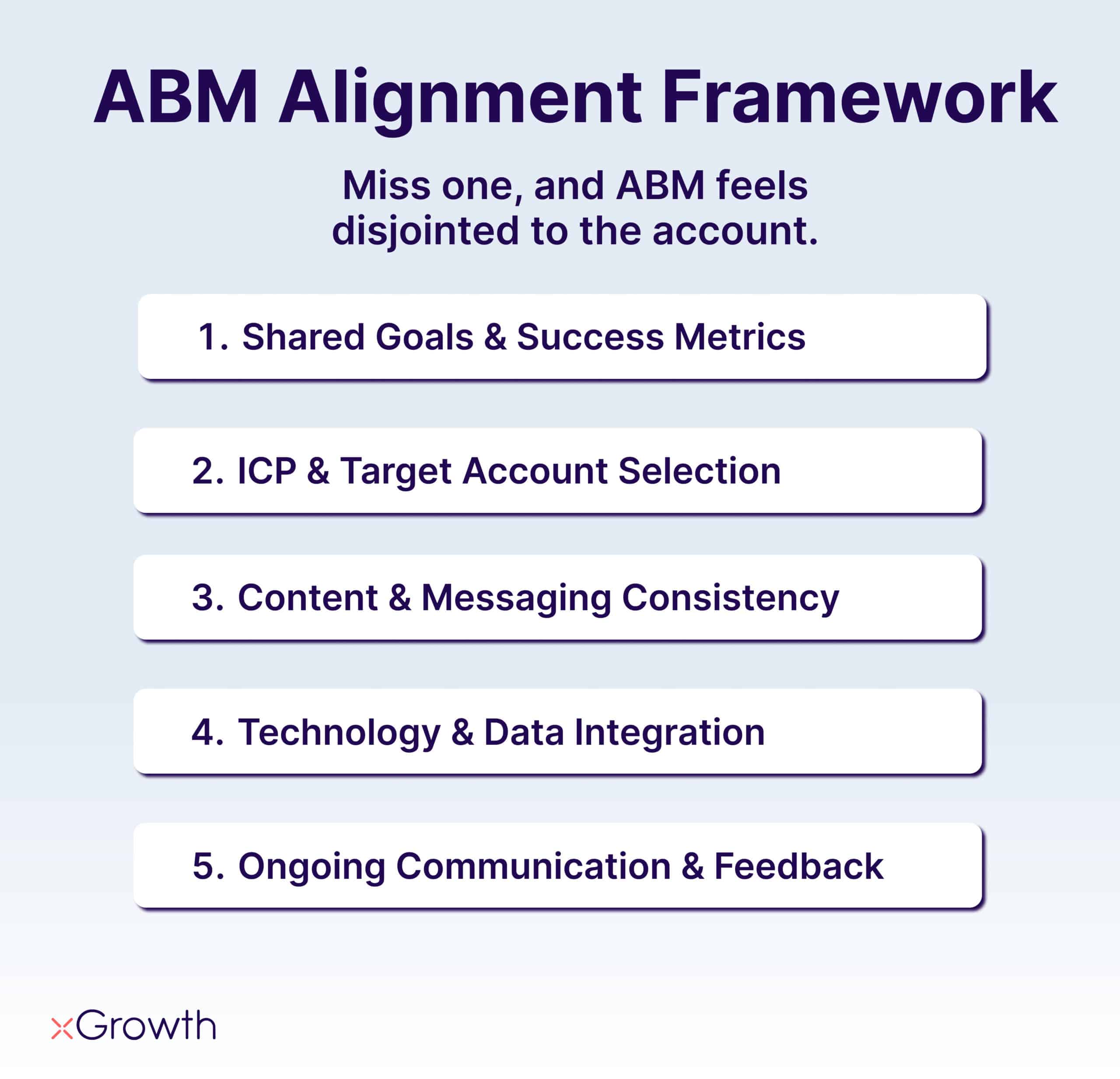
#1 – Shared Goals & Success Metrics
Most ABM failures start here: misaligned metrics. Sales chases pipeline, Marketing chases MQLs, and neither team really connects their work to the other. It’s frustrating to watch because both teams are working hard. But they’re just optimising for different wins. So neither one sees the whole story. Neither one can.
Alignment begins when both measure the same outcomes: target account engagement, buyer-committee meetings, named-account pipeline, and expansion revenue.
In practice, this means three shifts:
- Both teams use one dashboard. Not yours and mine. One.
- Pipeline and meeting metrics tie to specific accounts, not volume
- Activity metrics (opens, clicks, impressions) show what’s working, not overall success. They’re signals. Not the goal.
Here’s what changes when you actually do this:
Marketing stops obsessing over reach. Sales stops ignoring engagement signals. Both teams now chase the same wins (i.e., engaging accounts, booking meetings, and moving the pipeline). And suddenly, everyone rows in the same direction. It’s remarkable how fast things shift when that happens. The bottom line is that the different dashboards serve different goals. You measure activity, not alignment.
Having said that, the right metrics alone won’t guarantee the right targets. We then move on to the second pillar.
#2 – ICP & Target Account Selection
Account selection needs to be what it actually is – a negotiation between the two sides. Here’s what each side brings:
- Marketing brings the data. Firmographic fit, intent signals, and engagement history. The signals that say “this company looks ready”.
- Sales bring the reality. In-market timing, budget availability, and competitive lock-in. Something you learn by actually talking to people.
Both perspectives matter. The process unfolds in four stages, and this is where it gets practical:
First, marketing builds a long list using ICP criteria and intent signals. Next, sales applies real-world filters (such as timing, relationships, and known blockers). Then, both teams set account tiers (one-to-one treatment, one-to-few campaigns, one-to-many plays), so each account gets the right level of attention. Finally, both leaders sign off before outreach begins, ensuring that every campaign targets a vetted and ready audience.
Because when marketing targets unvetted accounts, resources vanish on deals doomed to fail. You’re throwing money and effort at accounts that were never actually ready. When sales pursues unprepped accounts, cold outreach stalls. Momentum disappears. The whole thing grinds.
The rule is simple. Both teams must approve every named account before launch. No exceptions. No “we’ll figure it out later”. No “let’s start and see what happens“.
#3 – Content & Messaging Consistency Across the Journey
Buying committees notice inconsistency faster than you’d ever expect.
If your LinkedIn ad emphasises cost savings, your SDR pitches innovation, and your AE (account executive) stresses compliance, you’ve now got three stakeholders inside the same account questioning whether you even understand them. This confusion kills deal momentum before sales even enter the conversation. It’s brutal.
The alignment layer fixes this. You need a single core message per account tier or segment. One. Then make sure it reaches every touchpoint, at every step, so the story stays consistent:
- Across ads, emails, SDR scripts, exec outreach, and event invitations. All of it.
- In your sales enablement assets (like battlecards, objection responses, use-case sheets)
Here’s how it actually works in practice: Before you launch a campaign, share the messaging framework with sales. Before an AE takes their first call, they should review what marketing has already said about that account. Not generic sales training. Specific context about that account. The handoff is more than just contact info. It’s the context (the story so far). When your buying committee hears one clear value prop from everyone, they remember competence. Not confusion. That’s the actual difference.
But messaging alone doesn’t close the loop. Even brilliant strategies collapse when data lives in silos.
#4 – Technology & Data Integration
As discussed in an earlier scenario, let’s imagine an executive downloads a white paper on Friday (a good sign, with an intent signal), but the SDR doesn’t see the signal until Tuesday. By then, momentum is gone. The window to follow up while intent is hot has vanished. A competitor probably already booked the meeting.
Real-time integration solves this. Start by making your CRM the single source of truth. Capture every signal so nothing gets missed. Feed engagement signals into it from marketing automation, intent platforms, and website analytics. All of it flowing into one place. Then watch what becomes visible: who engaged, what content they consumed, and when.
This unlocks two moves (and they work together). Sales acts on high-intent signals while they’re fresh, well before competitors do. Marketing refines campaigns based on what sales learns in live conversations. And before you realise it, both teams operate from a single account timeline rather than multiple fragmented snapshots. No guessing or “Did you see this?” Zero missed signals!
But here’s the test, and this is important: if your SDRs can’t see marketing moves in their workflow, or marketing doesn’t learn what sales discovered during calls, integration isn’t real. You have infrastructure without discipline. And that’s worse than having no infrastructure at all because everyone thinks they’re aligned when they’re not.
#5 – Ongoing Communication & Feedback Loops
Having the right tools matters. Using them together matters more.
Alignment requires ongoing maintenance. Markets shift, accounts go dark, competitors make moves. When communication stops (and it will), sales and marketing drift back into separate lanes within weeks.
The operating rhythm keeps the structure alive. You must protect it. Here’s what to run on repeat:
- Weekly ABM huddles: Review target account progress, surface blockers, and adjust next steps. This is where you catch problems early.
- Shared dashboard: Both teams see the same account status, engagement trends, and pipeline movement. No surprises. No fragmented snapshots. One view.
- Two-way feedback: Sales shares what they’re hearing in calls. Marketing adjusts content based on what works. The loop closes. Both sides actually listen.
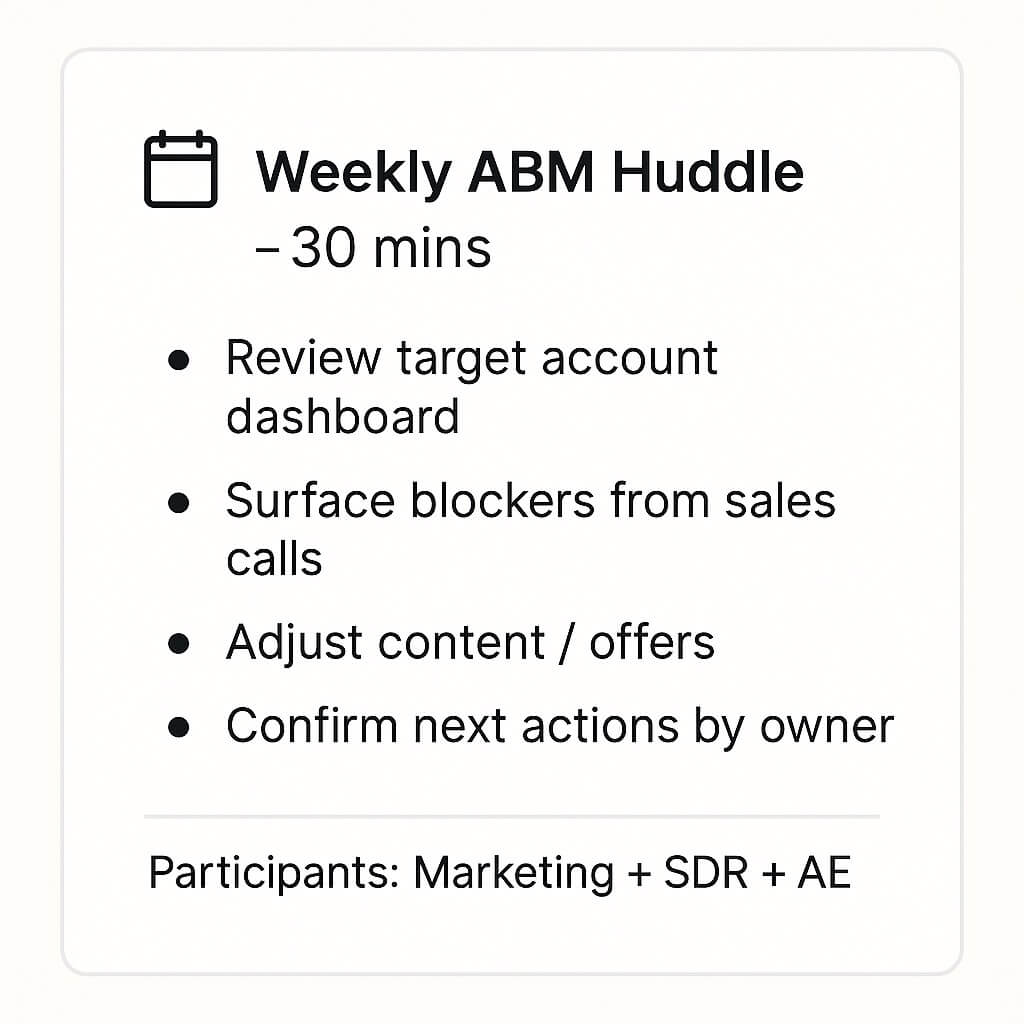
When this breaks (and it will), watch for the same patterns. Teams skip huddles after the launch excitement fades. Feedback gets buried in email threads instead of being surfaced immediately. Reporting lags for weeks, making insights stale before they’re useful. And stale insights destroy agility.
Here’s the hard truth: If your ABM feedback loop runs monthly, it’s already too slow. Maintain a weekly cadence, provide specific feedback, and take immediate actions. So momentum never stalls. That’s the discipline.
These five pillars create the alignment structure. However, structure alone doesn’t guarantee results. Next, we’ll dig into how to keep that system standing when executives change, priorities shift, and conflicts inevitably surface. Because they most probably will.
Best Practices to Keep Alignment Alive
Set-and-forget alignment fails in ABM. Market conditions shift. Team structures evolve. Buyer needs change. And when they do, if you’re not actively maintaining the alignment, it just evaporates. Sustained sales and marketing coordination demands active maintenance.
Five practices lock it in. Here’s how each one works:
Prioritise Executive Sponsorship
This is foundational. Both sales and marketing leaders must visibly own ABM results, not as a shared responsibility that gets diffused, but as co-ownership with teeth. The CMO and Head of Sales must jointly review results, approve budgets, and resolve any conflicts that may arise. It matters because when ownership is split, the moment a crisis hits, priorities drift. Suddenly, it’s “that’s marketing’s issue” or “that’s sales’ problem“. You lose momentum instantly. Formalise this co-ownership now, and it becomes your foundation. Without it, the following four practices crumble.
Assign an ABM Owner
Day-to-day alignment needs a single steward. Someone who runs weekly check-ins, updates target accounts, and acts on feedback. Give them authority to flag gaps or pause campaigns because stewards create actual continuity. When you have a competent steward, new hires onboard faster, and programs survive turnover. When no one knows who owns the work, practices slip through cracks. Small things get missed. Then they compound. Then suddenly alignment’s gone.
Document Core Plays
With ownership locked in, codify the work. Capture your key processes (e.g., launch steps, reactivation routines, expansion workflows). List owners, timelines, and handoff points. This document becomes your backbone because it outlasts individual contributors. It becomes the standard that new hires inherit. It’s the tangible thing you pull out when someone asks, “How do we actually do this?” Written processes stop the slow drift in which “How we do it” becomes folklore rather than a system. Folklore changes. Systems don’t. That’s the real difference.
Handle Conflicts with Protocols
Friction is inevitable. It’s going to happen. Lead ownership disputes, territory clashes, and account prioritisation battles all surface when two teams coordinate. Most teams stall simply because they handle each conflict ad hoc, decisions accumulate into precedent, and then chaos follows. Instead, set rules well in advance, follow up with target accounts within 24 hours, and split credit on shared wins.
Make these rules explicit and surface tension in weekly huddles. Resolve fast. Let friction fester, and alignment resets. You lose everything you built.
Built-in Reviews and Adaptation
The final practice ensures nothing becomes too rigid. Schedule quarterly or monthly reviews to prune cold targets and flag emerging priorities. Audit your messaging regularly. Test it against what sales actually hears in calls. Adjust account tiers as conditions change. This cadence matters because it stops your framework from becoming yesterday’s playbook. Without it, alignment survives the launch but dies in the quiet.
It is essential to point out that none of these work in isolation. Run all five together, and ABM delivers results through every market shift, every quarter, every challenge that comes.
Aligning Sales and Marketing for ABM Success
ABM is most effective when both teams actually work in tandem (report on the same metrics, jointly select accounts, tell a unified story, utilise shared tools, and hold weekly huddles). When they do all of that, high-value prospects experience seamless coordination from first touch to close. The teams that skip this alignment suffer duplicate outreach, missed follow-ups, and wasted budget. But those who lock it in see pipeline momentum and tangible ROI. And that makes all the difference.
But understanding the framework and executing it are two completely different things. Most teams grasp the five pillars. Yet knowing the playbook doesn’t guarantee you’ll actually run it. The real friction surfaces when you try to pick the right accounts, sync tools without friction, run huddles that move the needle, and maintain alignment as priorities shift. All of this requires structure, clear ownership, and real discipline. That’s where most teams stall.
Clearly, the difference between ABM frameworks that sit in strategy documents and ABM programs that actually deliver a pipeline is quality execution. So if you’re running high-value accounts without tight sales and marketing alignment, book a 30-minute consultation with xGrowth this week. We’ll diagnose where your alignment is breaking down and show you the fastest path to fix it. Because every week you wait is a week’s worth of deals that could be closing.
Start now.