
ABM campaigns often touch dozens of contacts without landing a single meeting. Meanwhile, teams that match message to role often book discovery calls in fewer touches, sometimes as few as three. The difference isn’t budget or timing. It’s understanding that IT decision makers don’t buy generic marketing; they buy the belief that you understand their pain points and what keeps them up at night.
Yet despite this insight, most sales cycles continue to fail at alarming rates. Forrester finds most buying efforts stall: ~86% of B2B purchases pause mid-process, 81% of buyers end up unhappy, and in enterprise tech, about 96% of cycles stall or drag on. The pattern is clear: complex buying processes and deep risk aversion within IT buying groups are stalling evaluations, and role-based personalisation provides each role with the proof it needs to progress.
This is exactly why targeted messaging matters so much. Personalisation in ABM campaigns means tailored content that addresses technical fit, risk assessment, and peer validation by IT stakeholder type. It works because generic value propositions consistently fail to move group evaluations past discovery.
The challenge is knowing where to start. Success hinges on understanding a few critical elements: why IT decision makers need completely different approaches, how targeted personas transform campaign results, and how proven practices scale personalised campaigns while maintaining alignment and measuring impact.
Why IT Decision Makers Need a Different Approach
IT buyers work with long timelines, complex tech needs, and high risk. Generic ABM approaches break against these three factors, so here’s why each factor demands a complete strategy reset.
Extended Buying Cycles Demand Different Engagement
Many enterprise tech purchases stretch 12+ months, while public sector decisions average ~22 months. Budget planning, technical reviews, and coordinating multiple internal teams create these timelines before big infrastructure commitments.
This length creates specific problems for ABM campaigns. Marketing automation built for quarterly software purchases becomes useless when buyers plan 18 months ahead. Your “limited-time” offers expire before buyers start evaluating, and quarterly campaign themes miss their annual planning calendars entirely. However, the timeline mismatch reveals just the surface problem. The real challenge runs deeper: IT buyers evaluate differently.
Technical Evaluation Drives Timeline Complexity
While other enterprise buyers assess business value, IT decision makers evaluate four things simultaneously:
- Technical architecture fit
- Integration requirements
- Security protocol compliance
- Vendor viability
A CTO weighing new SaaS will check API compatibility, where data lives, how it scales under peak, and what happens in the event of a failover. Talk “streamlined productivity” to a security architect and you’ll get nowhere until encryption standards and control frameworks are clear. That’s why technical evaluators quietly own the schedule.
This technical layer creates the real problems that generic ABM campaigns miss. Your campaign targets the economic buyer with ROI messaging while technical evaluators control both timeline and vendor qualification.
The disconnect becomes obvious when your “streamlined productivity” pitch reaches a security architect who needs encryption standards and compliance frameworks before any productivity conversation matters. This evaluation complexity worsens when operational risk is factored in.
Risk Management Creates Higher Evidence Standards
IT buyers carry operational responsibility that other roles simply don’t face. When marketing technology fails, campaigns pause. When IT infrastructure fails, revenue stops completely.
This asymmetric risk makes them incredibly selective about vendor meetings. They need to see:
- Peer validation from similar companies
- Reference architectures that prove system functionality
- Detailed implementation case studies with measurable outcomes
This effectively means that generic value propositions that work for other enterprise buyers often feel premature to IT stakeholders who haven’t yet verified basic technical compatibility.
Here’s the difference in practice. A marketing director schedules a demo after reading one case study, but an IT director needs integration documentation, security certifications, and references from similar environments before they’ll take that first call.
Put it together and you get a buyer who demands persona-specific proof. If you don’t meet the timeline reality, the technical depth, and the risk standard, even your best-fit accounts will sit in neutral.
The Power of Personalisation in ABM
Personalisation isn’t a buzzword here. It’s the actual job. Match what you say, what you show, where you show it, and when you show it to the person in front of you. Every touch must answer one question: “What does this person need to see next to move?”
But first, you need to understand who’s actually making these decisions.
Understanding IT Buyer Personas and Their Priorities
- CIOs think in outcomes – Will this help us grow, lower cost, outpace competitors? They want ROI, rollout timing, and how change lands across teams.
- CTOs think in systems – Does it fit our architecture, integrate cleanly, stay secure, and avoid long-term debt? Benchmarks matter, as does how it impacts developer and ops time.
- IT managers/directors think in Tuesday morning reality – Budgets, vendors, adoption, training, support queues, and whether users actually succeed.
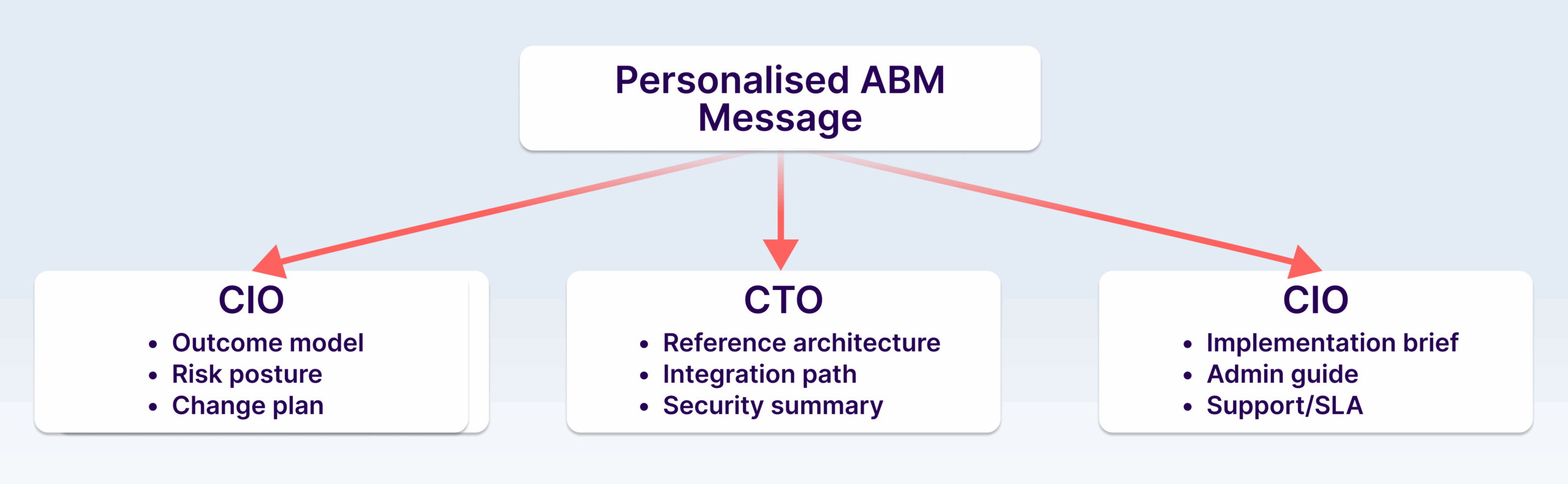
Here’s the disconnect: each role requires different proof points, conversation starters, and success measures. Generic messaging that tries to appeal to all three simultaneously works for none of them. This fundamental mismatch explains why most ABM campaigns stall – marketers build them for one audience, not three distinct decision-makers.
Tailored Messaging and Content Strategy
Technical teams crave architecture diagrams, connection specs, and performance data. They respond to content that demonstrates real product knowledge, tackles implementation challenges head-on, and provides concrete technical proof. Provide them with documentation, API guides, and detailed case studies from environments similar to their own.
Executive IT leaders, on the other hand, prefer business-focused stories that connect technical decisions to organisational outcomes. They want to see how trends create opportunities and how frameworks enable adoption strategies. They engage best through executive briefings, analyst reports, and peer discussions with leaders facing similar challenges.
The real danger zone is the handoff. A CTO says ‘feasible’ and kicks it to an IT manager. When a CTO refers your solution to an IT manager for evaluation, mismatched content can derail the entire process. The technical depth that convinced the CTO might overwhelm the manager, while business-level summaries might feel too superficial for their detailed review process.
Here’s how to bridge that gap effectively. When the CTO gives feasibility approval, hand the manager a concise implementation brief that speaks their language. When CIO sponsors get involved, follow up with executive summaries directly tied to their KPIs. Run both tracks in parallel so each role gets the right proof, at the right depth, in the right format. Absolutely no stalls.
Channel Preferences and Engagement Patterns
IT folks don’t learn the way most buyers do. They ask peers, haunt forums, and show up at conferences to hear what actually works. When they want the truth, they go to communities (not campaigns!)
Technical evaluators, in particular, live in developer communities, Stack Overflow discussions, and GitHub repositories. When they’re ready to evaluate solutions, they want hands-on experience (e.g., free trials, sandbox environments, and technical webinars) where they can ask detailed questions in real-time.
Executives take a different path. They read the trades, skim analyst notes, and attend small, invite-only sessions where they can swap war stories without the dazzling stage lights. So they value smaller, peer-focused discussions over large marketing events where genuine conversation gets lost in the crowd.
Meet them where they already are. Understanding these preferences allows ABM campaigns to meet prospects in their natural research environments rather than forcing them through traditional sales funnels. But here’s the thing: knowing where they gather is only half the equation. You also need to understand what they’re actively researching and why.
Use Data and Insights for Better Targeting
Personalisation clicks when three signals line up:
- Intent tells you what they’re hunting for right now (so your message feels timely, not nosy.)
- Company information and context tells you what’s possible given their stack and compliance constraints.
- Engagement history tells you their mindset. A technical whitepaper download ≠ a business case browse. This behavioural insight helps you create nurture sequences that feel natural and optimise the timing of sales handoffs.
Account-level insights add another layer by revealing the team dynamics that will affect purchase processes. Understanding team structures, recent technology investments, and existing vendor relationships helps you craft messages that resonate and identify potential champions or blockers within target accounts.
The challenge is connecting these insights to actionable targeting without making execution overly complex. While data provides the foundation, it won’t drive results on its own. Success requires coordinated execution between teams who understand how to use these insights effectively.
Get Sales and Marketing to Work Together
Effective targeting ultimately depends on sales and marketing teams working from the same playbook. This means creating shared understanding around role-based messaging and ensuring coordinated experiences across every touchpoint.
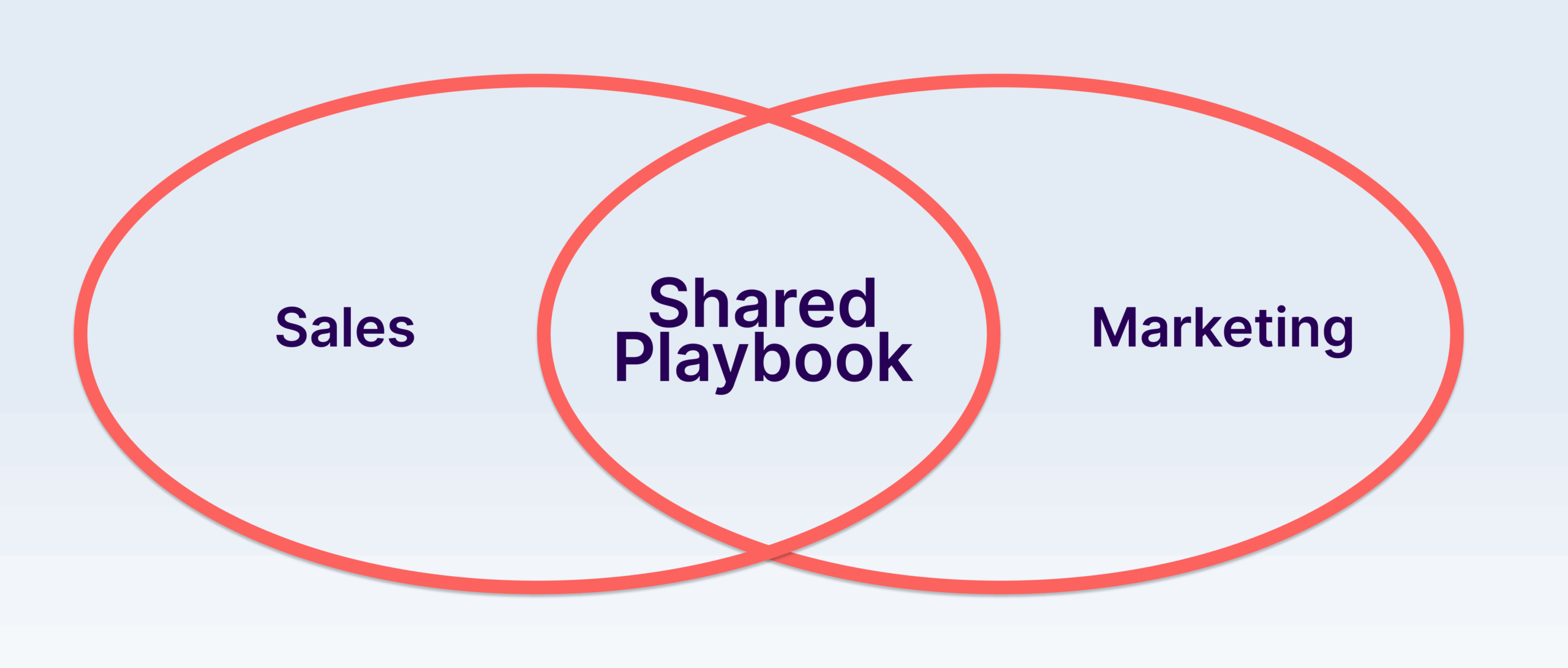
Simply speaking, great targeting looks like one team:
- Give sales the practical kit (e.g., persona talk tracks, objection cheat-sheets, and a small, sharp library of assets tied to the campaign). One-pager “first proofs” for each role help a conversation build instead of restarting.
- Have marketing pass the baton cleanly (e.g., who clicked what, what resonated, and which proof to open with next). Short notes beat long memos.
The challenge intensifies with IT buyers because technical and business conversations often happen simultaneously with different stakeholders. This means teams must coordinate carefully to ensure message consistency across both technical and executive touchpoints within the same account.
And because cycles are long, run regular feedback loops to learn what moved people, and adjust while the campaign is still running. That’s the only way to improve targeting effectiveness as campaigns mature.
Best Practices for Personalising ABM Campaigns to IT Buyers
Smart IT targeting requires a systematic approach, but it doesn’t have to be complicated. The key is balancing deep customisation with scalable execution while building measurement that actually proves ROI.
Practical Personalisation Tactics
Start with account-specific content hubs. These dedicated microsites work because they contain role-relevant case studies, technical documentation, and industry examples that speak directly to different IT stakeholders within the same company.
However, here’s the thing about content: it alone won’t close deals. Demos need to focus on the prospect’s actual tech environment. Skip those generic product tours that make everyone’s eyes glaze over. Instead, demonstrate integration scenarios that match their existing technology stack and address their specific security requirements, compliance needs, and performance standards. This is how you prove technical fit rather than just claiming it.
This technical focus should also extend to your social proof. IT buyers won’t engage vendors without peer validation first. That’s why industry case studies work so well. They highlight companies facing identical technical challenges and demonstrate measurable outcomes that prospects can relate to. At the end of the day, results speak louder than promises.
The execution principle that ties this all together is to create modular content pieces that combine into personalised experiences without requiring custom creation for every single interaction.
Balancing Personalisation with Scalability
Here’s where most teams get stuck: tactics work, but scaling them feels impossible. The solution lies in deploying three-tier approaches that match effort to opportunity:
- Strategic accounts get custom content and dedicated resources
- Mid-tier accounts receive industry-specific and role-specific messaging
- Broader audiences engage with persona-based content tracks that address common evaluation patterns
Standardise the machinery (i.e. role-based email sequences, demo scripts, and content picks), so teams deliver consistent experiences at speed. The real game-changer is letting technology amplify human effort rather than replace it. Deploy automation tools that deliver content recommendations based on engagement patterns and company data, while sales teams focus their custom efforts on the highest-value opportunities. This hybrid approach maintains the human touch where it matters most and scales touchpoints across your broader prospect population.
Measuring Personalised ABM Success
Scaling personalisation means nothing without measurement that actually connects to revenue. The problem is that traditional marketing metrics completely miss the nuanced impact on IT buying processes. That’s why you need to prioritise engagement quality over volume, especially when IT buyers spend extended periods with technical content and return repeatedly to specific resources throughout their lengthy evaluation cycles.
The metric that reveals actual impact is pipeline velocity. This measures whether your personalised approaches actually accelerate those complex, multi-stakeholder decision processes by tracking time between key milestones (from initial engagement to technical evaluation to vendor selection).
However, velocity alone overlooks the attribution aspect. It’s equally important to connect personalised touchpoints to revenue outcomes through deal influence measurement. Track which specific content pieces correlate with progression through evaluation stages and purchase decisions. Use account penetration metrics to show whether your strategies actually help engage multiple stakeholders within target organisations.
Moving Forward with Personalised ABM
IT buyers face long buying cycles, complex technical requirements, and serious risk concerns – all of which break standard (spray-and-pray) ABM approaches. Personalisation wins because it shows the right proof to the right person, right when they need it.
Keep it simple: tier your accounts to decide customisation levels and focus on metrics that actually drive meetings.
Show CIOs the business value and how you’ll manage risk. Show CTOs how you’ll integrate with their architecture and existing systems. Show IT managers your implementation roadmap and what ongoing support looks like. Each role needs to see different proof points. This targeted messaging amplifies your ABM impact.
Different roles, different gates.
A generic message hits none of them. With that in mind, if you are ready to put this into practice, pick one active ABM program and audit it. Find the role-specific gaps that cost you meetings, then test targeted content with your most valuable prospects. Start this week.
For faster results, book a 30-minute ABM Launch Consult with xGrowth, and we’ll map the personalised plays to your pipeline.
Error: Contact form not found.