

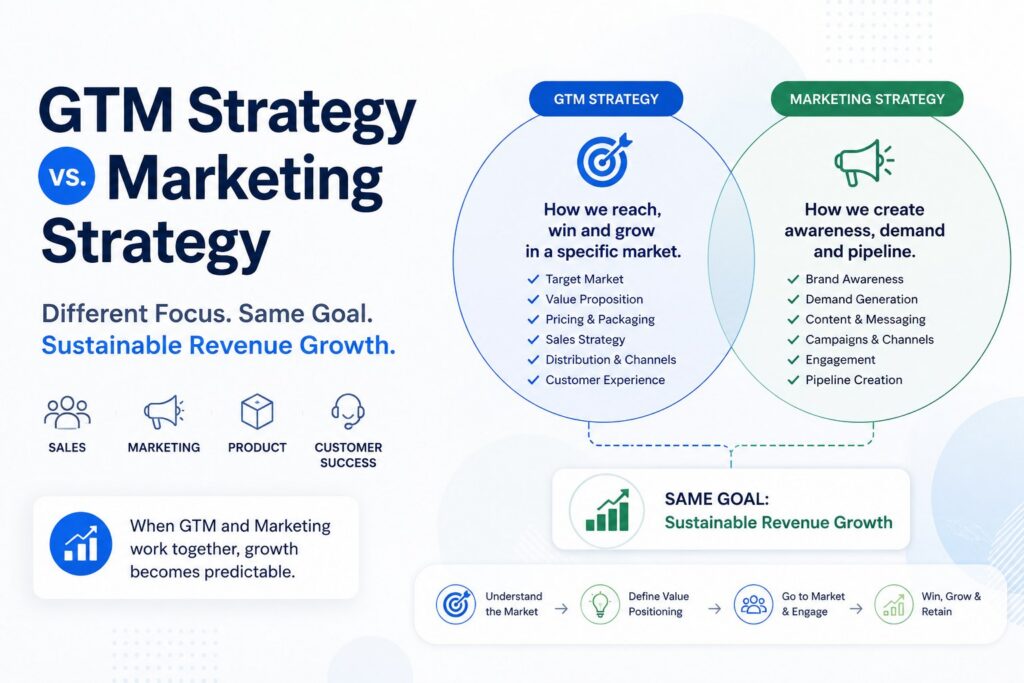
A go-to-market (GTM) strategy and a marketing strategy are closely connected, but the two terms can’t be used interchangeably. GTM strategies focus on how a brand reaches, wins, and grows a specific market while marketing strategies are all about ways to build awareness, demand, engagement, and pipeline.
Both strategies are crucial for success, so they should work together, especially for B2B since sales, marketing, product, and customer success all play a huge role in growing revenue.
What is a GTM Strategy?
A GTM strategy is a commercial strategy that a brand develops to bring a product or service into a market. It usually includes the following aspects:
- Target Market: GTM starts with identifying the businesses or groups of people most likely to buy your products and services.
- Ideal Customer Profile: Ideal customer profile (ICP) narrows down the target market by identifying the details of the specific type of company that will get the most value from your products/services.
- Positioning: B2B brands must determine how they want the product to be pitched to buyers, focusing on how it will benefit them.
- Sales Motion: Sales motions involve repeatable, structured methods to reach and engage with target accounts.
- Channels: A GTM strategy plans the specific paths and methods needed to reach the ICP.
- Pricing: B2B teams must work together to determine how pricing should be structured for target accounts.
- Customer Journey: Before implementing the strategy, the brand should plan the complete experience buyers will have with your brand, including everything from awareness to purchase.
- Measurement: Teams must align on what to measure to determine success, including outcome metrics, efficiency metrics, and leading indicators.
GTM strategies are usually cross-functional, including involvement from marketing, sales, product, partnership, and customer success teams.
What is a Marketing Strategy?
A marketing strategy defines a plan used to reach, educate, engage, and convert the right audience. These plans typically include:
- Positioning: Like GTM strategies, marketing strategies deeply consider how to shape the way accounts view the products.
- Messaging: Marketing teams execute the positioning by determining the best ways to communicate the product value, uniqueness, and core promises to potential buyers.
- Content: Using the planned messaging, the team brings it to life through written information and materials, such as articles, videos, and social media content.
- Demand Generation: Rather than focusing on short-term wins, marketing strategies find ways to spread long-term brand awareness and build trust over time.
- Campaigns: In addition to long-term tactics, marketing teams also create time-bound plans for specific business goals.
- Channels: Marketing strategies also consider the specific paths and methods needed to reach buyers, similar to a GTM strategy’s planning.
- Marketing Performance: Throughout the strategy, the team tracks how well the plan meets its goals by tracking data and adjusting the budget and focus as needed.
These marketing tactics support the broader GTM plan, but a marketing strategy doesn’t control every aspect of the business.
The Main Difference
Overall, a GTM strategy is broader and more commercially cross-functional while marketing strategies focus specifically on audience engagement, demand creation, and marketing execution.
| GTM Strategy | Marketing Strategy |
| “How do we win this market?” | “How do we reach and influence this audience?” |
| Cross-functional ownership | Led primarily by the marketing department |
| Helps grow in a market | Helps spread brand awareness |
| Starts with defining the target market and ICP | Starts with solidifying positioning and messaging |
Where GTM and Marketing Overlap
Even though these two strategies have different focuses, one brand can have both strategies occurring simultaneously. Therefore, there are many aspects GTM and marketing strategies share, such as:
- Definition for audience and ICP
- Positioning and messaging
- Channel strategy
- Campaign planning
- Content and sales enablement
- Measurement for engagement, pipeline, and revenue
Where GTM Goes Beyond Marketing
At their core, both strategies centre around the company’s values and goals. However, GTM explores areas beyond marketing, including:
- Sales motion and sales process
- Pricing and packaging
- Product readiness and market fit
- Partner strategy
- Customer onboarding and retention
- Revenue ownership across the entire customer journey
Where Marketing Plays the Biggest Role
A marketing strategy plays the biggest role when the brand needs to spread education and awareness about products and services. It’s necessary for demand generation, account-based marketing (ABM) strategies, content strategies, and thought leadership.
Websites, SEO, paid media, and events are all parts of marketing strategies. Throughout all aspects, the marketing team must track and analyse results and marketing-led pipeline contributions to determine if adjustments are needed for future marketing approaches.
When the Distinction Matters
Since both GTM and marketing strategies are important for B2B brands, the strategy names might not seem important. Yet, distinguishing the two matters when you need to focus on areas that are part of a GTM strategy but not always part of a marketing strategy, such as:
- Launching a new product or service
- Entering a new market, region, or vertical
- Shifting focus toward higher-quality products and accounts
- Repositioning an offer
- Fixing weak pipeline quality or poor sales conversion
- Aligning teams for growth priorities
Example Scenarios
A GTM strategy has a lot of detailed parts that can seem overwhelming until you put them into action. Below are some common situations where GTM and marketing strategies work together to increase revenue.
New Product Launch
Product launches include anything new your B2B brand has to offer, such as tools, major software releases, and platform expansions. GTM defines the market, offer, sales motion, and launch plan for the product while marketing focuses on demand and campaign execution.
Market Expansion
Approaches may differ if a B2B company expands to new regions or new industries. With market expansion, GTM defines the region, ICP, sales approach, and partners while marketing adapts the messaging and channels to match these new areas.
Enterprise Growth
New strategies may also be needed if your business expands in size, revenue, and/or market reach. GTM can focus on the account strategy and buying process while marketing can support ABM, content, and sales enablement.
Common Mistakes
When implementing a new GTM and/or marketing strategy, here are some frequent mistakes to avoid:
- Treating your GTM strategy as just a marketing campaign
- Building a marketing plan without clear ICP or sales alignment
- Launching campaigns before solidifying the offer, message, and sales process
- Measuring marketing activity without linking it to pipeline and revenue
- Expecting marketing to solve product, sales, pricing, or positioning problems
How xGrowth Thinks About GTM and Marketing Strategy
A strong GTM strategy sets up a commercial plan for a market, segment, or account group. A marketing strategy builds demand, engagement, and trust to help execute the GTM plan. Both strategies must align on ICP, messaging, account focus, and revenue measurement to operate smoothly.
xGrowth helps B2B brands bring all these moving parts together. We connect GTM planning, ABM, demand generation, and sales enablement to pipeline and growth outcomes to ensure every aspect of GTM and marketing plans are covered.