

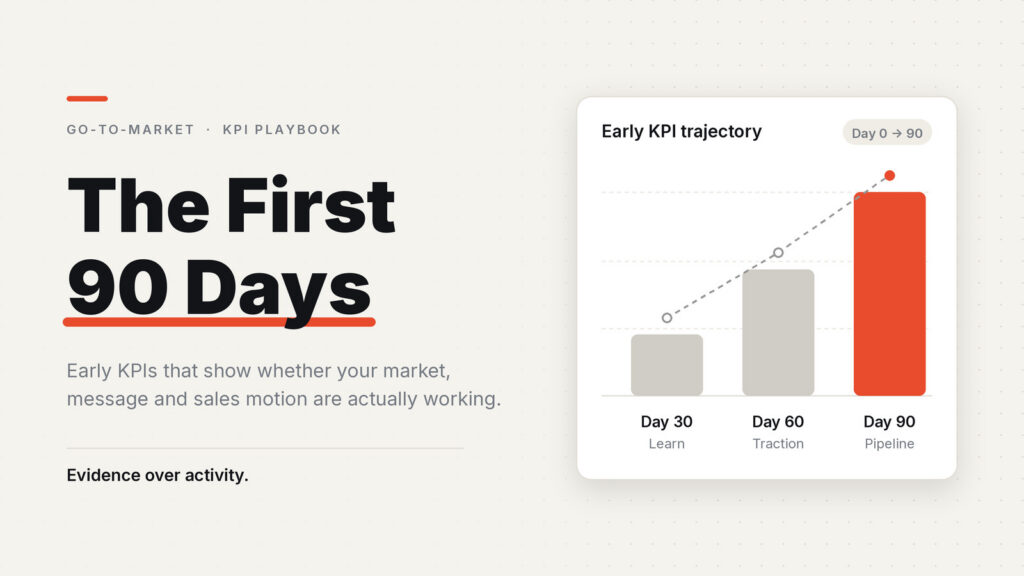
The first 90 days of a Go-To-Market (GTM) plan are all about learning, gaining traction, and achieving early commercial progress. Early key performance indicators (KPIs) can help teams understand if current efforts are working, including the market, message, channels, and sales motion.
A strong GTM plan’s goal isn’t just activity. It’s also important to have evidence that the strategy can achieve pipeline and revenue.
Why the First 90 Days Matter
Early results can give brands a good idea as to whether their GTM assumptions are holding up. KPIs can help teams decide which parts of the strategy should be kept, changed, or stopped. By spotting issues early on, sales and marketing can make adjustments before scaling spend.
What to Measure in the First 30 Days
In the first 30 days of your GTM plan, measure the following to make sure buyers are noticing your brand:
- Campaign and channel activation
- Target account coverage
- Website, content, and campaign engagement
- Sales readiness
- Early buyer feedback and objections
What to Measure from Days 31 to 60
Days 31 to 60 are when you’ll start noticing if engagement is turning into genuine interest, so measure the following:
- Meetings booked from target segments or accounts
- Qualified conversations and discovery outcomes
- Account engagement across key stakeholders
- Channel performance by quality, not just volume
- Sales follow-up speed and consistency
What to Measure from Days 61 to 90
By days 61 to 90, your brand should be seeing if target accounts are actually converting. Measure these aspects to be sure:
- Qualified opportunities created
- Pipeline value by segment, account tier, or channel
- Opportunity progression and stage movement
- Conversion from engagement to meeting to opportunity
- Early indicators of deal velocity and revenue potential
Leading GTM KPIs
The most important KPIs for a GTM strategy are the ones that show accounts moving forward in their buying journey. This includes:
- Target account engagement
- Stakeholder coverage
- Content and campaign response
- Sales activity on priority accounts
- Meetings and qualified conversations
- Message resonance and objection patterns
Pipeline and Revenue KPIs
When specifically looking at pipeline and revenue, it’s important to pay close attention to the engagement that could actually turn into opportunities. Therefore, brands should focus on these KPIs:
- Opportunities created
- Pipeline generated
- Pipeline quality
- Conversion rates by stage
- Average deal size
- Sales cycle movement
- Forecasted revenue from first-wave accounts
Sales and Marketing Alignment KPIs
It’s important for sales and marketing to be aligned on KPIs to ensure the approach stays consistent. The two teams should agree on target account adoption, follow-ups for engaged accounts, messaging, feedback loops, and what counts as a qualified pipeline.
Misalignment in these areas can make it harder for the teams to work together to determine what’s effective and what needs adjustments.
What Not to Overvalue Early
It’s easy to get excited about interactions and engagement early on, but overvaluing early indicators could make it harder to determine which aspects of the strategy are working. Avoid putting too much value in these early measurements:
- Impressions without account or buyer relevance
- Clicks with no commercial intent
- Lead volume from poor-fit companies
- Activity that doesn’t cause sales conversations
- Revenue without enough time for the sales cycle
How to Review GTM Performance After 90 Days
After 90 days, look at your KPIs and determine if any aspects of your GTM strategy need to be changed. Here are some steps for how to review your performance after the first 90 days:
- Compare the results to your original GTM assumptions
- Determine the most successful segments, accounts, channels, and messages
- Identify which areas of engagement, meetings, and opportunities have slow progress
- Decide where to optimise, expand, narrow, and/or reposition
If your goal was to achieve a certain amount of revenue or number of target accounts, but you’re not on track after 90 days, it’s especially important to look at all areas of your plan to decide which aspects are working well and which areas need new approaches.
Common Mistakes
Measuring GTM performance isn’t about tracking everything. It’s about tracking the KPIs that matter for gaining revenue and new accounts. Here are some common measurement mistakes to steer clear of:
- Measuring too many KPIs at once
- Expecting revenue too early in the sales cycle
- Reporting marketing activity without sales outcomes
- Ignoring sales feedback and buyer objections
- Scaling spend before solidifying the ideal customer profile (ICP), message, and channel mix
How xGrowth Thinks About First 90-day GTM KPIs
Throughout the first 90 days of your GTM strategy, make sure you’re focusing on learning, traction, pipeline quality, and commercial signals. xGrowth can help you measure and adjust your plan by connecting early engagement to sales action and opportunity creation while measuring by segment, account tier, channel, and sales motion.
The first 90 days are crucial for improving GTM execution before scaling. With xGrowth’s support, you can more easily prioritise metrics that show movement towards meetings, pipeline, revenue, and ROI.