
Launching in B2B tech is unforgiving. You face crowded markets, long sales cycles, too many decision-makers, and never enough time. Most companies know the basics, but still scatter their message everywhere, hoping the right accounts notice. This shotgun approach wastes your launch window.
Account-Based Marketing (ABM) for product launches changes the game. It lets you focus your limited resources on handpicked target accounts, align sales and marketing on coordinated plays, and build early momentum with prospects most likely to buy. Forrester research proves these programs deliver 21–50% higher ROI, with 23% achieving returns of 51–200% compared to traditional marketing. No wonder more companies are making the shift.
This guide teaches you how ABM transforms product launches for tech brands, how to build launch-specific frameworks, how to drive early adoption, and how to track the metrics that matter. You’ll get a clear roadmap to transform your next product launch from a marketing event into a pipeline-generating machine.
Why ABM is a Game-Changer for Product Launches
ABM turns launches from expensive guesswork into focused sales strategies. Rather than casting wide nets hoping the right buyers notice, you pick accounts most likely to buy. Then focus all launch energy on converting them.
Two realities make this focus non-negotiable in B2B marketing for tech brands:
- Buying is complex. Typical B2B decisions require 6–10 stakeholders, and 77% of buyers say the process feels difficult. ABM narrows your focus and aligns your message to the team you need to convince.
- Focused programs work better. Recent benchmarks prove ABM practitioners get higher returns than broad-based efforts, showing a simple truth: targeted programs pay back better.
Traditional Launch vs. ABM Launch
| Traditional Launch | ABM Launch |
| Broad market targeting | Named account list (tiered) |
| Generic persona messaging | Committee-specific narratives |
| Marketing-then-sales handoff | Coordinated sales-marketing plays |
| Volume metrics (e.g. leads, reach) | Account engagement + pipeline |
| Scattered resource allocation | Concentrated launch energy |
What Changes on Day 1 of a Launch with ABM
- Targeting: Pick specific accounts so every activity moves those buyers, not the whole market
- Messaging: Address specific team concerns rather than generic buyer types
- Coordination: Align marketing campaigns and sales outreach around the same accounts
- Tracking: Use engagement signals to spot interested prospects and start real conversations first
This focused approach eliminates three launch problems: scattered messaging, wasted budget on unlikely buyers, and conflicts between sales and marketing.
Bottom line: If your last launch felt scattered, ABM brings the focus you need. But this raises an important question: which accounts actually deserve that focused attention?
Building an ABM Framework for a Product Launch
Most ABM programs target companies in existing markets with proven playbooks. But B2B Tech product launches need something different: you’re creating demand, not just capturing it. A specialised framework builds momentum through five connected steps, from picking target accounts to closing first deals. Each step feeds the next, creating a chain reaction that traditional launches can’t match.
1. Defining the Target Account List Early
Start with the end: which accounts are most likely to close in quarters 2-4 post-launch?
ABM for launches demands tighter, earlier selection. You bet resources on conversion odds, not market size. It’s surely a higher-stakes approach, but that’s precisely what makes it effective.
Standard firmographics (company characteristics used for B2B segmentation) won’t cut it – you need to identify accounts with actual buying momentum. Add “early adopter signals” to your ideal customer profile: accounts using similar solutions, recent funding, new leadership, or public initiatives that align with your product. These buying signals drive launch success more than basic company fit. Timing beats demographics when you’re working within tight launch windows.
This expanded criteria might leave you with too many potential candidates. Solution is to tier your list, strategically:
- Tier 1: 25 – 50 accounts you’d bet the quarter on (deploy comprehensive approach with deeply personalised campaigns, executive engagement, and dedicated resources)
- Tier 2: 50 – 100 that need steady pressure (execute targeted campaigns with role-specific content and coordinated outreach
- Tier 3: 100 – 200 to keep in the loop (run awareness campaigns with nurturing content and automated touchpoints that keep you on their radar)
Smaller lists create focus. Bigger lists create diffusion.
Choose focus to win deals.
Bottom line: Name your top 25 targets and explain why they’ll buy in six months, or revise your list (i.e. replace it with a better candidate).
2. Tailored Messaging & Positioning
Once you know who to target, craft messaging that compels action now. Launch content solves a different problem than demand gen. It explains why now, not just why ever. Your audience knows the problem exists. Show them why your solution changes everything today.
Build role-based stories around specific value:
- Security buyers need threat solutions they couldn’t address before
- Finance buyers need cost projections and time-to-value estimates
- IT buyers need integration requirements and support specifications
Each committee member responds to different “why now” triggers. Generic messaging fails when buying committees demand specifics.
Test this messaging before launch through executive briefings, analyst calls, and customer feedback sessions. Once your launch window opens, there’s no time for experimentation. You can’t A/B test value messages for three months after launch (the market moves too fast for that!)
Bottom line: Lock your messaging first, then begin content creation with clear direction.
3. Content & Campaign Alignment
When you’re creating launch content, remember that you’re serving entire buying committees, not just individual personas. Create assets that multiple stakeholders can consume and share internally (think executive briefings, ROI calculators, implementation guides, and competitive comparisons).
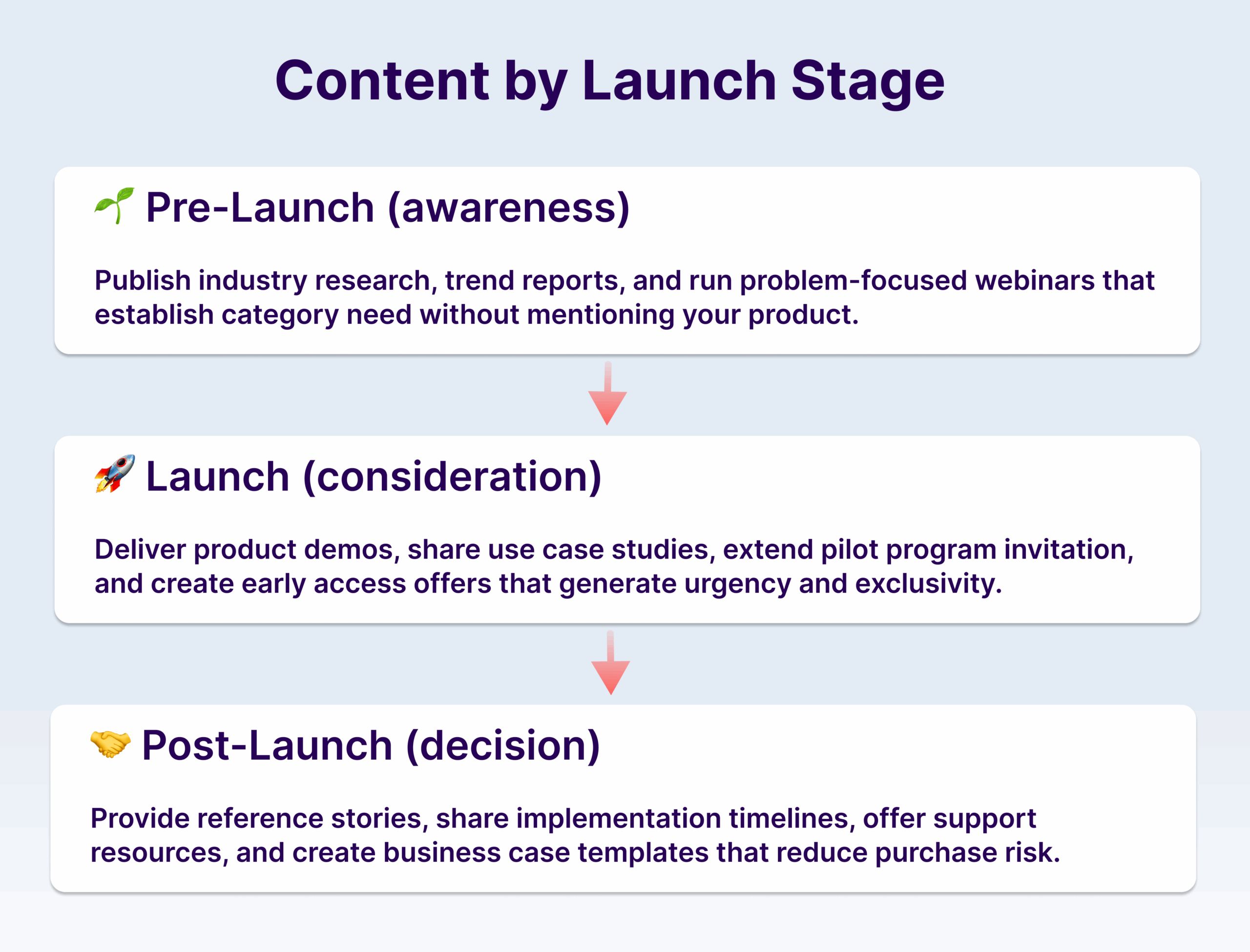
Content by launch stage:
- Pre-launch (awareness): Publish industry research, trend reports, and run problem-focused webinars that establish category need without mentioning your product
- Launch (consideration): Deliver product demos, share use case studies, extend pilot program invitations, and create early access offers that generate urgency and exclusivity
- Post-launch (decision): Provide reference stories, share implementation timelines, offer support resources, and create business case templates that reduce purchase risk
Map this content to your tiers. Give Tier 1 accounts custom presentations and dedicated webinars. Provide Tier 2-3 accounts scaled versions through email campaigns and targeted ads.
Bottom line: Design every piece to answer “why this solution” and “why now” for a specific committee role.
4. Sales & Marketing Sync
While content creates awareness, it’s the alignment between your teams that actually drives conversions. Build coordinated plays with clear handoffs and response times that both teams follow consistently.
- Launch plays: Marketing warms targets through content and events. Sales reaches out within 24-48 hours based on engagement signals.
- Account playbooks: Create sequences that coordinate marketing touches with sales activities. When marketing runs executive webinars for Tier 1 targets, sales follows up within two business days with contextual outreach that references specific attendee questions and engagement patterns.
- Launch SLAs (service level agreements): Set up SLAs that make sense. Marketing delivers qualified engagement data, sales provides conversation feedback, and both teams share intelligence about buying committee makeup and timing. This creates a feedback loop that benefits everyone.
The goal isn’t traditional lead handoffs: it’s moving accounts forward. Both teams work the same targets with coordinated messages until accounts either close or opt out.
Bottom line: If sales and marketing don’t share the same dashboard and update each other weekly, you’re essentially running two separate launches instead of one unified ABM motion.
5. Using Tech & Data
Coordination demands visibility. Product launch ABM requires faster signal detection and response than regular pipeline programs because you work compressed timelines with focused account lists. This creates smaller windows for action and higher stakes.
- Intent data: During launches, prioritise buying signal speed over volume: a company that consumes three pieces of content in one week shows higher intent than one that consumes five pieces over two months. Start by layering such intent data on your target list to identify which companies research your category.
- CRM integration: Connect your marketing automation platform with launch-specific scoring that weights recent activity higher than historical engagement. For instance, score an executive who attended your webinar last week higher than someone who downloaded a whitepaper 6 months ago.
- Marketing automation: Use dashboards that show engagement across all touchpoints: website visits, content downloads, event attendance, social media activity, and sales interactions. This visibility lets both teams see account warming in real-time and coordinate next moves precisely.
Bottom line: Use tech to speed decisions, not create reports. If your launch dashboard doesn’t help you decide which company to call first tomorrow, fix it.
Best Practices for Driving Early Adoption
Move from framework to execution with one goal: turn account interest into unstoppable momentum.
Make the shift simple. Transform building awareness into creating lighthouse wins (i.e. successes that speed up every conversation and make your launch story sell itself).
Pilot Programs & Lighthouse Wins
Start early adoption with structured pilots. These reduce risk for both parties. Instead of asking targets for full implementations, successful ABM launches offer limited trials. These prove value quickly and create internal champions: people who will advocate for your solution inside their organisations.
Design your pilot so it can’t drift:
- Define scope (focus on a specific use case or department)
- Set success metrics (establish results that can be achieved within 60-90 days)
- Provide dedicated support (assign resources that guarantee pilot’s success)
The key is to make trials feel exclusive and position accounts as strategic partners, not just customers.
You’ll create lighthouse wins when your pilot programs deliver results that participants actually want to share with others. This happens when solutions solve visible problems, deliver measurable ROI, or enable previously impossible achievements. The best wins create advocates who reference your work, speak at events, and help close other targets.
Early success becomes your most powerful sales asset. But only if you capture it and amplify it effectively.
Advocacy from Early Adopters & Quick Customer Stories
Here’s the truth: adopter advocacy speeds launches more than any marketing campaign. When respected accounts say your solution works, peers listen. The challenge is to build advocacy systems before you have dozens of customers.
Structure successful advocacy around three stages:
- Find natural advocates during trials (champions who see clear value)
- Capture their stories quickly (within 30-60 days of implementation)
- Amplify their voices through case studies, webinars, and peer conversations
Don’t overcomplicate quick customer stories with elaborate case studies. Focus on setup speed, specific problem resolution, or early ROI indicators. A finance director saying “We cut costs 20% in the first month” carries more weight than generic testimonials about “great partnership.”
Peer validation works for one reason: buying committees trust peer experiences more than vendor presentations. Create effective advocacy through peer-to-peer sharing:
- Executive roundtables
- User groups
- Private briefings where prospects ask real questions
Turn every successful trial into advocacy. Turn every advocate into a reference for similar accounts.
Measuring Impact
ABM demands different metrics than ongoing pipeline programs. You measure focused effort over compressed time. In launch ABM, “more leads” isn’t the point. Progress and pace are.
Track three metric categories:
- Pipeline creation shows movement. Watch the share of Tier-1s that actually engage, how long it takes to reach a qualified opportunity, and whether those deals are bigger than your broad-market work. These metrics show whether focused approaches outperform broad-market tactics, and by how much.
- Deal velocity tracks how ABM accounts move through sales stages compared to inbound leads. ABM accounts typically move faster because coordinated sales and marketing approaches pre-qualify them more effectively. Measure cycle time reduction and stage conversion rates specifically for your target list.
- Product adoption signals matter 30-60 days post-launch when customers start using your solution. Track how quickly they get set up, which features they’re using most, and when expansion conversations begin within those accounts. The adoption data you gather from your lighthouse customers will help predict future success with similar prospects.
Start by freezing a baseline. After that, care about improvement. An ABM programme that converts 15% of targets with 40% shorter cycles beats one that sprays 500 leads for a 2% win rate.
Bottom line: Optimise for focus and speed. Not volume and reach. Fewer deals, faster deals, bigger deals.
Ready to Launch
ABM can transform how your B2B tech product launches succeed by helping you focus your efforts on the right accounts, align your sales and marketing teams, and build real early adoption momentum. When you focus launch energy on a named, tiered set of accounts instead of chasing broad market volume, everything changes. You coordinate with sales around real buying committees, speak to actual pains, and create early wins that become references other prospects trust.
You now have the complete framework – Why targeted focus beats scattered campaigns, how to execute the five systematically connected components (account selection, launch messaging, committee-ready content, coordinated sales plays, and data-driven acceleration), and proven tactics for turning pilots into advocacy that carries your story forward.
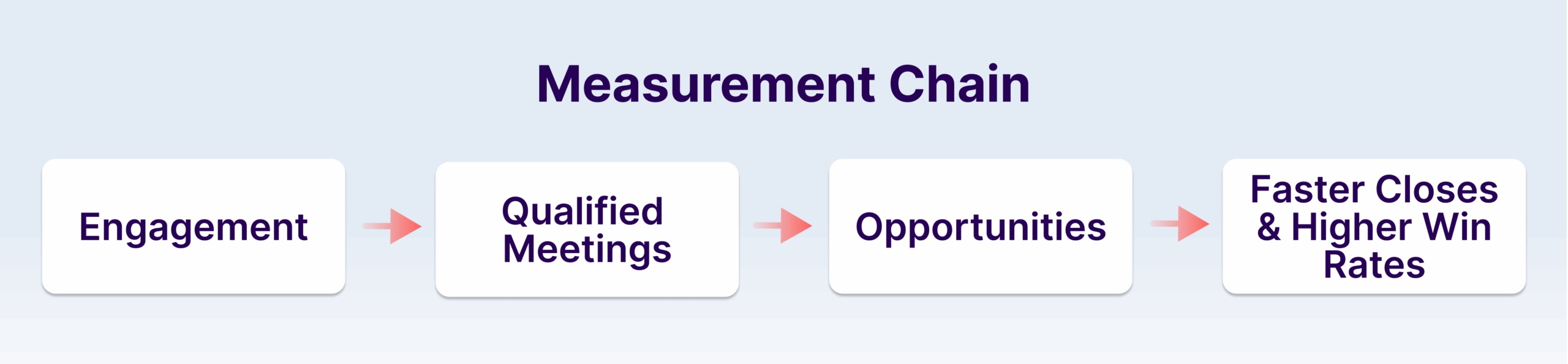
The measurement chain is simple: Engagement → qualified meetings → opportunities → faster closes at higher win rates.
Early customers then become proof points that pull the next wave in.
Quick audit:
- Is your account list named and tiered by conversion odds?
- Have you crafted messaging that addresses real committee concerns rather than generic personas?
- Have you aligned sales and marketing to execute coordinated plays with clear follow-up protocols?
Closing even one of these gaps will likely transform your launch performance in the coming quarters.
This week, audit your launch approach and identify your biggest opportunity. If you need experienced hands on the wheel, book a 30-minute ABM Launch Consult with xGrowth.
Error: Contact form not found.