

Enterprise buying rarely hinges on one person. You’re dealing with six to ten stakeholders, and the bigger deals often run 6-9 months. Most teams default to adding more account executives (the salespeople who manage client relationships) and sales engineers (the technical specialists who demonstrate product capabilities), assuming that enterprise sales is a purely relationship-driven game. However, it is rarely a headcount problem. Relationships matter, but marketing can’t sit out when consensus is the real hurdle.
Fact is, buyers research without talking to vendors. 97% check your website. 81% read third-party reviews before they’ll even meet with sales. That’s why the enterprise GTM (go-to-market) strategy needs marketing to lead. Marketing builds trust, educates buyers, and aligns stakeholders across the whole journey, long before sales gets an invitation.
This article shows how to build a marketing-led strategy for enterprise buyers. We’ll cover why this market needs a different approach, the five core pieces of a marketing-led strategy, and how to execute it so you stay credible even when priorities shift.
Why Enterprise Requires a Different Marketing Strategy
Complex cycles need coordinated help
Enterprise deals don’t just take longer. They work completely differently. Multiple teams (IT, finance, security, legal, operations, end-users) each have their own priorities, speak their own languages, and worry about distinct risks. The journey isn’t straight. Teams loop through defining problems, exploring solutions, setting requirements, and picking vendors, often more than once.
One account executive can’t handle all that alone. This complexity demands marketing coordination: aligning messages across roles, timing content to match buying stages, and maintaining momentum when internal priorities shift.
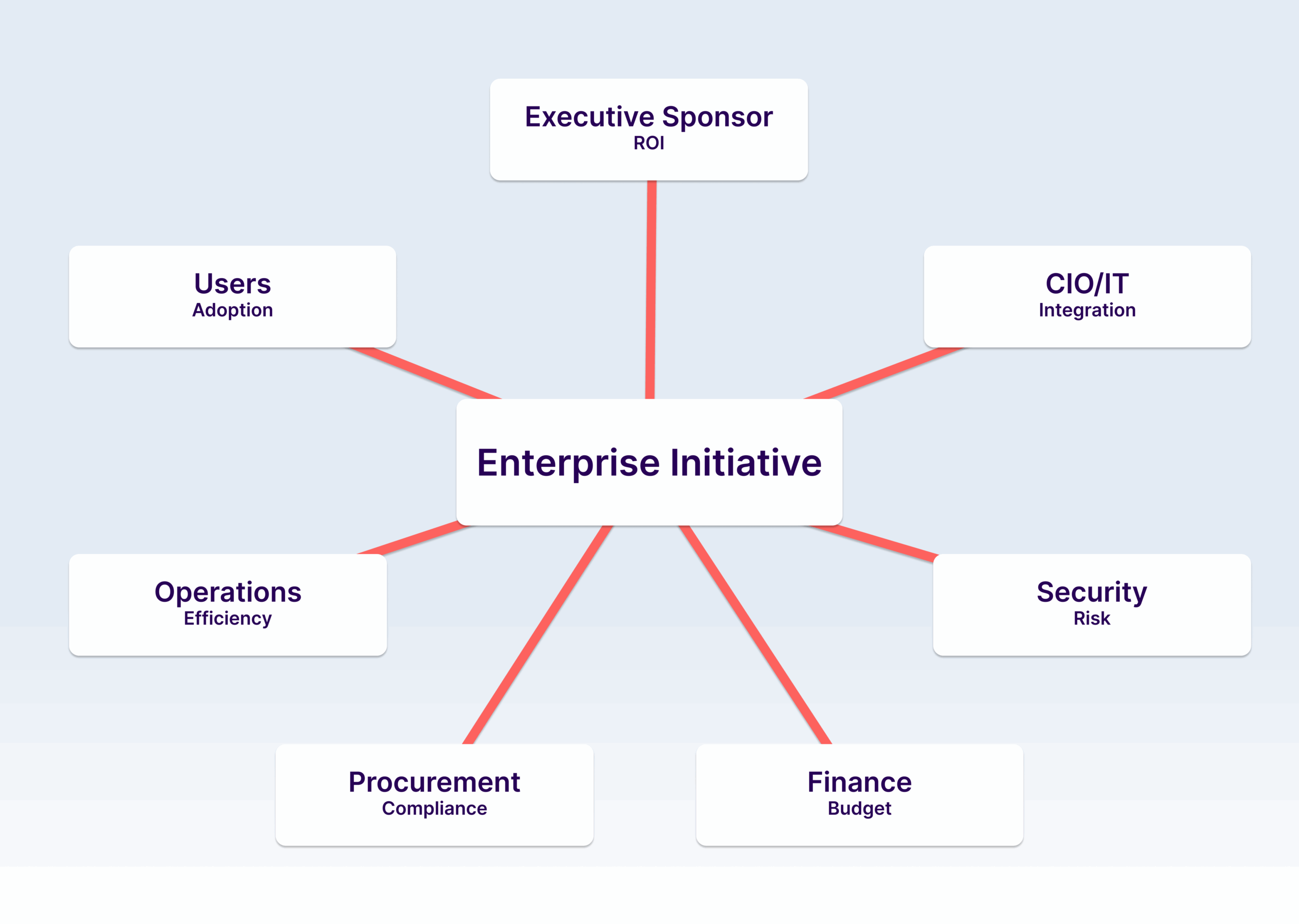
Bottom line: If your GTM treats enterprise like “mid-market, but bigger,” you’ll miss the real bottleneck: getting multiple stakeholders to agree.
Marketing’s key role in building trust
The trust problem starts with credibility.
As discussed earlier, most buyers research first (e.g., roughly 75% prefer to learn without a rep early on). So trust has to exist before sales is even invited. Build competence-based trust by publishing sharp industry points of view, shipping detailed case studies, demonstrating technical proof, and adding third-party validation. Then deliver the right proof to each stakeholder in the format they value.
When marketing lays that groundwork, sales shows up to a conversation that starts with “How do we make this work?” instead of “Why should we trust you?” This cuts friction and improves results while avoiding unrealistic timeline promises.
Bottom line: Don’t ask sales to build trust from scratch. Equip them with accounts that already understand the problem, the approach, and the proof.
Core Pillars of an Enterprise Marketing GTM Strategy
1. Market Segmentation & Account Selection
Enterprise success starts with ruthless focus on the right accounts. Unlike volume-based approaches, enterprise marketing demands surgical precision in finding accounts that match your ideal customer profile by behaviour, not just size.
Look beyond company size and revenue. Instead, find concrete fit and readiness signals: firmographic match (industry, revenue, employee count), tech stack indicators (current tools, recent purchases), intent signals (e.g., content they consume, what they search for), and trigger events like leadership changes, funding rounds, contract renewals, or regulatory pressures.
Effective enterprise programs work a tiered model. Typically, Tier 1 (about 5–25 perfect-fit accounts) gets bespoke content, dedicated campaigns, and executive access. Tier 2 (roughly 50–150 strong-fit accounts) gets semi-personalised plays. Tier 3 scales out to 500+ through programmatic content and digital touchpoints. Same message, different levels of depth and resourcing.
This progression needs clear entry and exit rules for each tier. Quarterly reviews must evaluate engagement scores, stakeholder mapping completion, buying signal strength, and competitive positioning. Then, set specific thresholds:
- Tier 1 requires 3+ engaged stakeholders and an active project timeline
- Tier 2 needs 2+ engaged contacts and an identified budget
- Tier 3 shows basic engagement and fit
This system ensures resources flow where they’ll actually convert.
Bottom line: Start with 10-20 perfectly matched Tier 1 accounts rather than 500 loosely qualified ones. Depth beats breadth every time.
2. Messaging & Value Proposition
Depth applies to messaging, too. Enterprise buying committees speak different languages. A CFO weighs ROI and risk, an IT director worries about integration and security, and end users care about simplicity and productivity. Generic messaging that tries to please everyone convinces no one. You need one core story with fluent translations for each role.
So effective enterprise messaging follows a hub-and-spoke model. The hub contains your core value proposition: the fundamental problem you solve and the unique way you solve it. Create a messaging matrix that maps each spoke to role-specific language, pain points, and proof requirements.
This essentially means you turn the core story into concrete spokes. For CFOs, lead with financial models and risk-reduction frameworks. For IT, show architecture diagrams and security certifications. For users, prove workflow gains with real productivity metrics and a simple demo path. Each spoke should feel written for that person while staying consistent with the overall position. That’s what “we did our homework” looks like. Plus, this messaging matrix becomes your content creation roadmap. Every piece is tailored to meet the specific needs and buying stages of individual stakeholders.
Bottom line: Create one core message with detailed role-specific translations documented in a messaging matrix.
3. Content & Thought Leadership
Enterprise buyers don’t just want more content: they need deeper insights. Surface-level blog posts won’t move the needle on $500K decisions. These stakeholders are looking for genuine industry expertise and insights they can’t find anywhere else.
This means you need to match your content to what each role actually cares about. CIOs want security whitepapers and integration guides; CFOs need ROI calculators and cost models; end-users want workflow checklists and productivity benchmarks. Technical teams dive into implementation guides while executives prefer strategic frameworks and trend analyses.
Case studies become your secret weapon here, but not just limited to success stories. For instance, you could create detailed guides showing how similar companies solved real challenges, including timelines, resources, and measurable results. Series formats (e.g., webinars in a sequence) outperform one-off events because they build familiarity and show depth over time.
But creating great content is only half the battle. Genuine thought leadership means taking clear positions on industry trends, regulatory changes, and best practices. When prospects see your executives quoted in trade publications or speaking at conferences, it builds the kind of credibility that sales calls alone simply can’t achieve. This requires creating consistent content calendars, building strategic relationships with analysts and journalists, and positioning executives as recognised experts through bylined articles and speaking opportunities.
Bottom line: Fewer, deeper, role-specific pieces beat high-frequency fluff every time.
4. Multi-Channel Campaigns
Creating great content is just the beginning of the puzzle. Different stakeholders consume information in entirely different ways. Your procurement contact reads newsletters, your technical evaluator follows industry forums, and your executive sponsor attends conferences and reads analyst reports.
Here’s what actually works: map your content and touchpoints to specific stakeholder journeys with account-level measurement. Target executives on LinkedIn with strategic content while focusing Google Ads on technical searchers looking for implementation guides. Segment your email sequences by role and buying stage, and use account-based advertising to reach multiple stakeholders within target accounts at the same time.
The secret sauce is keeping your message consistent across channels while adapting the format and emphasis for each platform. One whitepaper can become a LinkedIn series, a conference deck, an email sequence, and a display ad set. Same insight, different wrappers. This approach requires account-level scoring that tracks engagement across channels, maps stakeholder progress, and measures buying signals rather than getting caught up in analysing individual channel performance separately.
| Roles | Week 1 | Week 2 | Week 3 | Week 4 |
|---|---|---|---|---|
| Exec | Exec POV memo | Webinar | ||
| Technical | Tech guide | |||
| Finance | Case study + AE ask |
Campaign Orchestration dashboards should answer three key questions: which accounts are active, who inside those accounts is leaning in, and what content is moving them. That’s the cue for sales to time outreach and tailor relevance.
Bottom line: Design your campaigns at the account level with unified measurement, then execute across channels rather than running separate campaigns that end up competing for attention.
- Sales & Marketing Collaboration
The multi-channel campaigns only work when sales and marketing actually operate as one revenue team. This means having shared lead definitions, joint account planning, and truly collaborative content creation. Marketing provides the air cover while sales works the ground-level relationships.
Make collaboration operational. Anchor it in a weekly deal desk where sales and marketing review account progression, surface content gaps, and plan coordinated outreach. Set SLAs that matter (e.g., marketing turns custom content in 48 hours, sales sends monthly feedback on message fit and competitive intel.)
Make account intelligence sharing systematic rather than leaving it to chance. Marketing tracks account priorities, news, org changes, and triggers. Sales returns signal from the field (e.g., what lands, where deals stall, how competitors position). The loop makes targeting sharper and selling easier.
Content collaboration goes way beyond basic sales enablement. Sales teams require custom presentations and ROI calculators tailored to specific deals. Marketing needs customer quotes, implementation details, competitive intelligence, and objection insights. When both teams actually contribute to development, the result is content that’s both more credible and more useful for buyers.
Bottom line: Measure marketing success by sales outcomes, including pipeline quality, deal velocity, win rates, and contract value, rather than relying solely on traditional lead volume and engagement metrics.
Best Practices for Enterprise Marketing Execution
When your strategy is solid, execution becomes everything.
Two fundamentals separate winning teams from the rest: proof that builds lasting trust and relationships that pay dividends over time.
Maintaining Credibility Through Proof
Enterprise buyers don’t just evaluate your product, they’re sizing you up as a potential long-term partner. Every piece of content, every campaign, every interaction either builds that trust or chips away at it. When deals involve six-figure investments and multi-year commitments, there’s no room for sloppy execution.
Here’s what credible vendors consistently deliver:
- Name your sources when you cite statistics (and eliminate any “studies show” claims without attribution)
- Share exact metrics with timeframes and implementation details instead of vague success stories
- Build conservative calculators with transparent assumptions, worst-case scenarios, and phased timelines so buyers can model realistic outcomes
- State potential obstacles upfront and include mitigation strategies in your projections (this demonstrates you’ve thought it through)
- Choose quality over quantity: one thoroughly researched whitepaper beats ten generic blog posts when you’re building real authority
The difference between credible and generic proof comes down to one thing: specificity always wins.
Compare these two approaches:
- Generic claim: “40% productivity improvement.”
- Credible proof: “Global manufacturer reduced quality inspection time from 3 hours to 1.2 hours per batch, saving $2.3M annually across 12 facilities.”
When prospects can plug your claims into their own context and still see clear value, that’s when trust starts to build.
Your content quality becomes a key factor in establishing your reputation in the market. So invest in primary research, seek analyst validation, and get peer reviews before you publish thought leadership. Buyers have long memories for vendors who exceed expectations, as well as equally long memories for those who overpromise and underdeliver.
Bottom line: Under-promise and over-deliver on every claim to build the kind of credibility that lasts.
But credibility alone won’t get you to the finish line.
Building Long-Term Relationships
Enterprise marketing plays out over months, not weeks. The account you’re nurturing today might not have a budget for 18 months. That executive you’re educating through your content series might switch companies next year and become your champion elsewhere. This reality demands an entirely different approach to metrics and a lot more patience.
Smart relationship building starts long before anyone enters an active buying cycle. Publish genuinely valuable content, share relevant industry insights, and engage thoughtfully on LinkedIn to build recognition over time. The payoff comes when that executive finally has both budget and urgency, and you’re already on their short list.
Track momentum, not just MQL math. Watch brand-mention sentiment, executive engagement patterns, and the growth of your referral network. A prospect who shares your content, attends your webinars, and connects with your leadership is warming up (even without filling out a form).
In-person touchpoints (conferences, exec roundtables, customer advisory boards) turn familiarity into trust and intelligence. Yes, these investments take time to pay off. And we’re talking years, not quarters.
Bottom line: Track how quickly you can activate relationships (not just how fast you can build pipeline!) When buying triggers finally activate, warm relationships cut your sales cycle in half.
Adapting When Priorities Shift
Your strategy appears solid on paper, but enterprise priorities continue to shift.
New leadership walks in with fresh priorities. Economic uncertainty forces budget cuts. A competitor launches something that changes everything. Regulatory changes pile on new requirements. Your marketing has to roll with all of it without breaking.
That’s why you need adaptability built into your campaign architecture. Instead of creating rigid, linear programs, design modular content and flexible messaging that pivot quickly. When your champion suddenly shifts from “cut costs” to “drive innovation,” you need materials that speak to both worlds (without starting from scratch!)
But modular content is just the beginning. You also need multiple relationships across the buying committee, not just one contact. When your primary champion leaves or switches roles, those secondary contacts become your lifeline. This relationship breadth pays dividends when the org chart gets reshuffled.
The smart move is to monitor early warning signals that predict these shifts. Executive team changes, analyst reports, earnings calls, and competitive moves often telegraph priority changes before anyone announces them.
Bottom line: Build flexible campaigns around stable value propositions. Your core message remains consistent, while the tactical emphasis adapts to changing priorities.
Ready to Execute
You’ve built the framework. Now it’s time to put it to work. Enterprise buying takes time and involves multiple stakeholders who require trust, proof, and tailored messages for each role. A marketing-led GTM builds credibility early, engages stakeholders strategically, and aligns with sales consistently to drive long-term success.
Clearly, the bottleneck isn’t headcount; it’s actually credibility and stakeholder alignment. Marketing has to stage the education long before a demo: role-specific value stories, credible proof, and consistent touchpoints that move internal consensus forward.
This approach works because it builds trust at scale while sales focuses on relationship-driven closing. The result is that you turn “Why should we trust you?” conversations into “How do we make this work?” partnerships.
Ready to build your marketing-led GTM strategy?
Error: Contact form not found.