

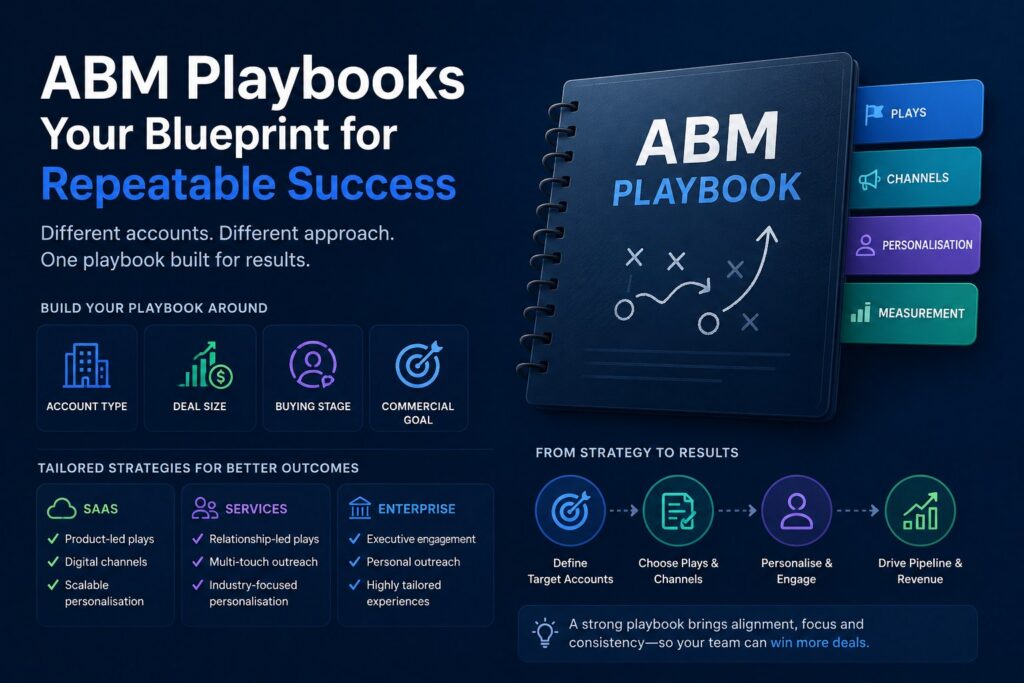
Account-Based Marketing (ABM) playbooks are the key to turning strategy into repeatable sales. A strong playbook should be built around account type, deal size, buying stage, and commercial goal for best success.
SaaS, services, and enterprise ABM often require different strategies for plays, channels, and personalisation. For example, playbooks that target a short, highly-specific list of accounts will require much more personalisation than a playbook targeting hundreds of accounts.
So, how should you build your unique ABM playbook?
What is an ABM Playbook?
An ABM playbook is a structured set of actions used to reach target accounts. A comprehensive playbook includes plans for account selection, messaging, campaigns, sales outreach, and follow-ups to ensure every part of the play is covered.
Playbooks are more than just campaign ideas; they’re practical execution tools.
What Every ABM Playbook Should Include
For a complete plan, an ABM playbook should include the following:
- Target account type or segment
- Commercial objective
- Buyer roles and stakeholders
- Key message or offer
- Channels and touchpoints
- Sales actions and follow-up
- Success metrics
SaaS, services, and enterprise playbooks all include these core elements, but the different types of ABM require different considerations.
SaaS ABM Playbooks
SaaS ABM playbooks should focus on product value, use case fit, adoption triggers, and growth potential since those are crucial aspects for software companies. Depending on the company and goals, the playbook might need to include competitor displacement, product-qualified account follow-ups, expansion into existing accounts, and vertical-specific campaigns.
SaaS companies can use content, product proof, demos, comparison assets, paid media, and sales outreach to connect with target accounts. From there, they should measure meetings, demos, pipeline, conversion rates, and expansion revenue to see which efforts lead to further engagement.
Services ABM Playbooks
Rather than selling a product or software, selling services focuses on providing expertise and outcomes, which can vary greatly based on the client’s needs. A services ABM playbook should be centred around trust, expertise, problem clarity, and business outcomes. Target account education, executive engagement, market entry support, and strategic account development can all help you introduce your services to target accounts.
Use thought leadership, workshops, diagnostic offers, case studies, events, and direct outreach to connect with potential clients while personalising messaging to fit their goals and pain points. Measure account engagement, senior stakeholder meetings, opportunities, proposal value, and revenue to track the success of your efforts.
Enterprise ABM Playbooks
Enterprise ABM focuses on a highly exclusive list of high-value accounts, requiring brands to focus heavily on complex buying committees, long sales cycles, and high-value opportunities. Some examples of enterprise playbook tactics include one-to-one account plans, deal acceleration, multi-threading, executive alignment, and renewal/expansion plays.
Content should be highly personalised and stakeholder-specific. Use intent signals, direct mail, events, executive outreach, and sales enablement to further drive your plan forward. Throughout the process, it’s best to measure stakeholder coverage, account progression, opportunity movement, deal velocity, and revenue impact.
Example Playbook Structure
A strong playbook structure should include the following:
- Trigger: Figure out when it’s the right time to engage with your target account and why
- Account insight: Gather as much information as you can about the account
- Message: Determine the problem or opportunity your product or service brings to the account
- Touchpoints: Decide what marketing and sales will do at each stage
- Follow-up: Plan how sales will react when there’s engagement
- Outcome: Think about what you want your play to achieve
Creating a spreadsheet or table to see the full picture can be beneficial in the early stages. Decide the timeline and actions needed for each step.
Choosing the Right ABM Playbook
Account tier, buying stage, deal size, and sales priority can all affect the playbook you use. Lighter plays are great for broad account segments while strategic or enterprise accounts require highly personalised plays.
Over-engineering every play could waste time and resources. Avoid spending too much time personalising plays for accounts that don’t justify the effort.
How Sales and Marketing Work Together in Playbooks
Sales and marketing should be aligned on the goals and messaging of every play. However, each team will have a unique role when it comes to bringing the playbooks to life.
Marketing starts by creating account insight, messaging, content, and campaign touchpoints. Then, the sales team adds relationship context, prioritises outreach, and drives conversations to move marketing’s efforts forward.
The two teams must agree on timing, ownership, follow-up, and success measures from the start. Once the play is put into action, feedback and results should be used to improve future plays.
Common ABM Playbook Mistakes
ABM playbooks involve a lot of learning and adjusting based on results, but avoiding these common mistakes can give your brand an extra boost:
- Building playbooks without clear account selection
- Creating campaigns that sales doesn’t use
- Using the same play for all accounts
- Personalising too much without a clear commercial reason
- Measuring activity instead of account progression and pipeline
How xGrowth Approaches ABM Playbooks
xGrowth helps brands build ABM playbooks that are tailored perfectly to target account lists, account tiers, buyer needs, and commercial goals. We connect every ABM strategy to practical campaigns and sales actions to drive success.
We can adapt plays to all types of brands, including SaaS, services, and enterprise, while making adjustments for scenarios that require market expansion and account growth. xGrowth helps brands create playbooks that achieve quality engagement like meetings, opportunities, pipeline, and revenue so you can meet your business goals.