

Monday, 9 AM. Marketing team reports 240 MQLs delivered last month, but the sales team counters: “Maybe 12 fit our ICP, and half ghosted after discovery.“
The CMO highlights content downloads. The VP of Sales points to a stalled pipeline. Nobody’s wrong, and the tactics themselves work. But the system connecting them doesn’t.
The missing system is a rigorous GTM strategy that ties who you target (ICP), what you say (messaging), where you engage (channels), and how teams execute and learn (alignment and measurement) into one connected plan. It turns growth marketing tactics such as demand gen and ABM into compounding results. Despite this critical role, fewer than half (47%) of B2B marketers operate with a structured GTM framework. Even more telling: 53% couldn’t even define “GTM” correctly.
This post explains why tactics stall without a GTM framework, how it connects strategy to execution, and how to add it without disrupting your current demand gen.
The Growth Challenge in B2B Marketing
Most B2B companies don’t lack marketing effort. They’re running campaigns, producing content, attending events, and testing new channels. Yet their growth marketing investments plateau in returns, and the usual response is to do more of the same, louder. Three friction points explain why:
Long Cycles, Misaligned Teams, Weak Differentiation
B2B growth stalls when three bottlenecks converge:
- Sales cycles stretch beyond 90 days as buying committees (groups of 6-10 decision-makers) multiply
- Marketing and sales can’t agree on what “qualified” means
- Messaging sounds identical to competitors because no one has defined a sharp ICP or unique value proposition.
And it’s easy to understand why. Long cycles compound misalignment. Marketing celebrates MQL volume, while sales waits months for a single decision. This misalignment worsens when weak differentiation turns every deal into a price conversation. Prospects can’t distinguish capabilities, so they default to cost comparisons and endless evaluations.
The result: high activity, flat pipeline, and review meetings where teams talk past each other. It is safe to say that adding more marketing tactics won’t solve a system problem. The absence of a shared operating framework is the actual issue.
How Marketing Tactics Fail Without GTM
Growth marketing tactics (demand gen, content, events, ABM) create activity. Without a GTM framework, that activity doesn’t compound. Here’s what breaks:
- Targeting splinters – Campaigns launch broadly because no one defines buying committee roles (i.e., who makes decisions, who influences, and who blocks). Messaging speaks to everyone and resonates with no one.
- Content piles up – Sales teams hunt for the right asset during live conversations because no one organises content by buyer role or purchase stage.
- Channels multiply – LinkedIn, email, events, and partnerships compete for budget with no clear hypothesis about where target accounts engage. Coverage stays thin.
- Handoffs break down – Leads enter using a scoring model (a point system for ranking prospects), but sales doesn’t trust it, creating a gap where prospects disappear.
- Measurement splits apart – Marketing tracks MQLs, downloads, and event attendance. Sales tracks pipeline and close rates. These dashboards never reconcile, so neither team learns what converts.
This isn’t a competence problem. It’s in fact architectural. Marketing executes tactics; GTM defines the system that those tactics plug into. It answers who to target, what to say to each role, where to show up, how teams hand off, and what signals matter. Without it, effort doesn’t compound.
With that, we are done with the diagnosis. Now here’s how a GTM strategy creates the operating system that connects these pieces and turns isolated tactics into compounding growth.
The Role of GTM in Driving B2B Growth
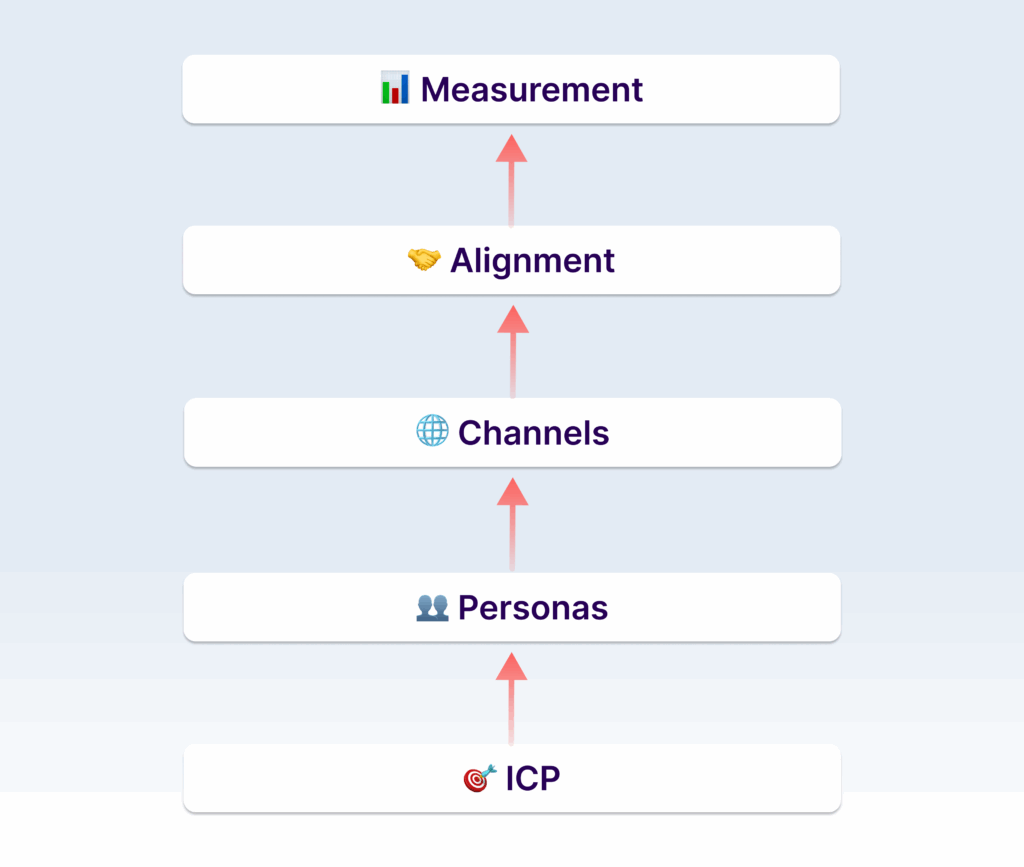
GTM strategy addresses the bottlenecks above, not by adding more tactics. Instead, it connects five pieces (ICP, messaging, channels, sales plays, and measurement) into one system. When these pieces work together, they multiply your results instead of just adding to the noise.
Market Segmentation & ICP Definition
Start with your Ideal Customer Profile (i.e., the companies that match your value proposition). Think of an ICP as a filter, not a demographic sketch. You apply it using:
- Firmographics: company size, revenue, industry
- Technographics: the tools and platforms they use
- Behaviour signals: how they engage and show intent
- Strategic value: their revenue potential and growth trajectory
Without these clear tiers, you spread effort equally across unequal opportunities. And you waste the budget chasing accounts that won’t convert. ICP frameworks fix this by helping you segment accounts into treatment tiers so effort matches potential:
| Tier | Criteria | Treatment | Example |
|---|---|---|---|
| Tier 1 | High fit + intent signals | One-to-few ABM, role-based nurture, targeted campaigns | Series B SaaS (200-500 employees) with recent funding and buyer engagement |
| Tier 2 | Good fit | One-to-many programs, scalable content, automated nurture | Mid-market IT firm (50-200 employees) that fits ICP but no intent yet |
| Tier 3 | Fit or intent only | Self-serve, product-led growth, partner channels | Startup (<50 employees) or out-of-vertical account that lacks fit or budget |
When you tier like this, you prevent two common failures: marketing spreads budget equally across unequal opportunities, while sales chases deals that can’t close at the contract value you need.
Buyer Personas & Messaging
Segmentation shows which accounts to target. Personas take it further. They show how to reach the actual people making decisions. Start by mapping the buying committee, which includes the Economic Buyer, Technical Buyer, Champion, and Influencer. Figure out what each role values, what they measure success by, and what makes them resistant.
Then translate your features into outcomes they care about. Here’s what that looks like in practice:
- Take a CFO. She doesn’t care about your API uptime metrics. Instead, what keeps her up at night is cost predictability and risk mitigation.
- Consider a DevOps lead. He’s not tracking quarterly earnings. He’s worried about deployment speed and keeping incidents low.
Generic messaging (the “we help you grow faster” variety) forces prospects to do translation work. They have to figure out how the features address their specific problems. Most won’t bother. They’ll stall, then ghost you.
The fix: match content to roles and stages. Know which asset (case study, ROI calculator, technical brief, executive summary) serves which role at which stage (awareness, consideration, decision). When you build this content map, your sales team stops scrambling for “something for the CTO” during live calls. They already have it ready.
Channel & Campaign Strategy
Now that we have covered who to target and what to say to them. Channel strategy answers the third question: where do you show up?
It also determines how you coordinate touchpoints based on account tier:
- Tier 1 accounts receive coordinated campaigns (account-based advertising, SDR outreach sequences, role-specific email nurture, and targeted webinars)
- Tier 2 accounts run through scalable programs (content syndication, email automation, retargeting ads, webinar funnels, and nurture workflows)
- Tier 3 accounts follow self-serve paths (SEO-driven content, product-led growth motions, community forums, and partner-led referrals).
A common mistake at this stage is that teams often launch channels without first considering alignment. They run LinkedIn ads to “all decision-makers in SaaS” or sponsor events where their ICP doesn’t even attend. Then they wonder why the cost-per-lead climbs while the conversion rate stays flat. They’re present everywhere but effective nowhere.
Channel strategy also defines the mechanics of your sequences: how many touches, over what timeline, through which channel mix, before a prospect qualifies or exits the funnel. When you document these plays, reps stop inventing their own approaches. Instead, they execute proven patterns and learning compounds across the team.
Sales & Marketing Alignment
Alignment isn’t weekly syncs. It’s the system that stops leads from vanishing between teams. Three practices make this real:
- Document handoff criteria – Marketing passes leads only when the fit score plus the intent score hit thresholds you agree on.
- Set speed-to-lead SLA – Sales contacts Tier 1 leads within 4 hours (or whatever your conversion benchmark indicates works).
- Build a feedback loop – Within 48 hours, sales marks each lead as Good Fit, Bad Timing, or Poor Fit. Marketing uses those signals to refine targeting.
Without this system, pipeline reviews turn into blame cycles. Leads ghost. Nobody learns what actually works.
Measurement & Feedback Loops
Without full-funnel visibility, you optimise one stage and break another. That’s why GTM measurement tracks the complete path: from account engagement through pipeline to closed revenue.
The questions that drive learning:
- Which ICP segments convert fastest?
- Which messages actually move deals?
- Which channels source pipeline that closes?
- What’s the lag between first touch and each subsequent stage?
Use these answers to close the learning loop monthly:
- Review ICP fit versus closed deals. Do you win where you predict?
- Refine scoring, messaging, or channel mix based on what converts.
- Adapt by killing low-ROI plays and doubling down on what works.
When dashboards track volume (MQLs delivered, emails sent, meetings booked) without showing how accounts actually move through stages or which segments convert, teams optimise for motion instead of growth. That’s how the same mistakes repeat every quarter (i.e., feedback never reaches strategy.)
GTM Implementation Strategy
You see the five layers that connect tactics to revenue. Now here’s how to embed them without stalling current work.
Build Foundation, Then Layer Over Time
Most teams freeze when they see a complete GTM framework. They assume six months of planning before they can launch another campaign. That’s the wrong approach. The real path is to build the foundation in 30 days while demand generation continues. Then layer measurement and refinement as data accumulates.
Month 1 (Build Foundation)
Start by defining ICP tiers with sales and leadership: Tier 1, Tier 2, Tier 3. Next, map buying committee roles for your top two segments (who decides, who influences, who blocks). Then document current handoff criteria and pick one shared pipeline metric.
This foundation clarifies targeting, so Month 2 can put it to work.
Month 2–3 (Operationalise)
Now, build role-based messaging for the Economic Buyer and Technical Buyer, matching pain points, proof, and outcomes to each role. Pick primary channel plays per tier: Tier 1 gets ABM plus targeted outbound and nurture sequences, Tier 2 gets scalable inbound programs (content syndication, email automation, webinars), and Tier 3 follows self-serve paths (SEO, product-led growth, partner channels).
Once campaigns run with clear targeting and handoffs, refinement becomes systematic.
Ongoing (Refine)
Each month, review the fit versus closed deals and adjust the scoring and channel mix accordingly. Each quarter, update personas based on win-loss interviews and retire low-ROI plays.

Balance Demand Generation with Positioning
Most CMOs say, “We can’t pause lead gen to build frameworks. The board wants the pipeline this quarter.” However, a better strategy is not to pause. Instead, you tighten your aim while campaigns run. Demand gen fills today’s pipeline. GTM makes it convert and compound over time. To capture both, narrow targeting to Tier 1 and Tier 2 accounts where conversion rates are highest, cut Tier 3 spend entirely, and reallocate those dollars to segments that actually close.
Start by testing role-based messages in one campaign (e.g., run separate LinkedIn ads for CFOs versus CTOs), then track which performs better. Next, add a simple sync (such as 15 minutes each week) where sales flags which leads fit, and marketing adjusts the targeting accordingly. This creates a loop that teaches you what works. No extra overhead required.
The key is not treating GTM like some side project you’ll get to later. Every campaign you run becomes part of your system (i.e., sharpening your ICP, testing messages in real contexts, tracking conversions by tier, and getting smarter each cycle).
When pipeline pressure hits (and it will), most teams panic and spray their message broadly just to hit the number. Do the opposite. Narrow down to your best segment and focus on closing more deals within that segment. Focus multiplies results while broad campaigns dilute them.
Common Mistakes to Avoid
You’ve got the framework now. The next step is dodging six traps that stall most teams trying to implement GTM:
| Don’t | Do |
| Make ICP so broad that it fits everyone | Tier accounts by deal size, fit signals, and value. Then focus resources where they matter |
| Build personas from demographics alone | Map personas to who actually decides, who influences behind the scenes, and what each role needs to hear |
| Launch everywhere at once | Start with your best accounts and with 2-3 channels you know convert, then expand |
| Send sales a deck and call it enablement | Build talk tracks together and keep updating them after every win/loss call |
| Track only MQLs and demo requests | Track fit scores, how fast accounts move through stages, and which tiers actually close |
| Build your plan and stop | Review monthly, kill what fails without mercy, and double down on what wins to compound growth |
The worst mistake is to target broadly because you’re afraid of missing deals. But here’s what actually happens: Broad targeting spreads you thin, blurs your message, and makes you look generic to everyone. Focusing narrowly on the tiers where you consistently win, however, drives faster and more sustainable growth.
What to Do Next
You’ve seen why marketing tactics stall without connective tissue. Long sales cycles, misaligned teams, and weak positioning compound when there’s no framework holding them together. You also learned how GTM drives growth through five integrated layers (ICP definition, role-based messaging, channel strategy, team alignment, and measurement loops). Together, these transform scattered work into a repeatable system.
You now have a practical path to embed GTM without stopping current work (i.e., build the foundation in 30 days, operationalise over 60 days, then refine monthly). Most B2B teams lack this structure, which is why pipeline pressure without systems creates motion instead of momentum.
Act now, and in 90 days, your pipeline reviews will show clear fit rates, deal velocity by tier, and close rates you can predict. Wait, and next quarter will mirror last quarter (which means more spending, the same friction, and the same blame cycles).
That Monday morning call where marketing and sales argue past each other ends when both teams operate from the same system. If you need help, book a 30-minute ABM Launch Consult with xGrowth this week. Together, we’ll map your tiers, define your buyers, and plan your first 90 days.
Error: Contact form not found.